Community map update

The ‘Mapping the Patch’ project being run by King’s Cross Community Projects and funded by the staff led Community Challenge at E C Harris, had its latest update today.

Click here to go to the community google map

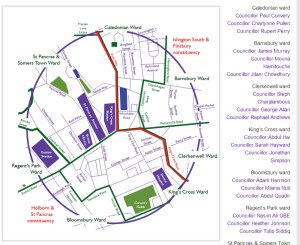
The map aims to list all the community groups within a half mile of KX Station. It also lists schools & colleges, support organisations and cultural organisations. It will eventually be combined with the political map the group has already produced.

KCCP hope to contact all local community groups this spring to find out what their needs and interests are. Following that, community groups will be invited to a networking event to meet each other informally and further develop the links and shared interests between them. All the information gathered will be freely available online. KCCP hopes to produce a useful and practical community resource information base as a result. If you know of additional community groups that should appear on the map, please email KCCP here with details.

Posted in Community groups | Tagged , , , , | 1 Comment

Kings Cross through the eyes of a contemporary artist – Gwendi Klisa

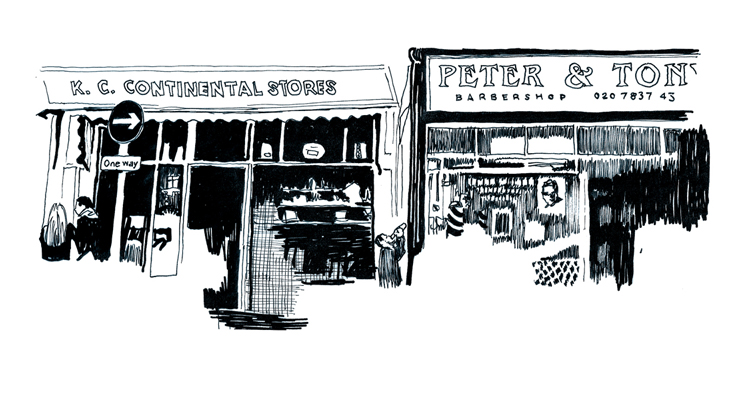
The professional illustrator Gwendi Klisa  has been a Kings Cross resident for several years now.  I recently came across her art-work via her web-site  www.klisas.com and discovered some beautiful and recent illustrations of Kings Cross.  Feeling passionate about Kings Cross she kindly agreed that I may publish two of the drawings here. Gwendi explains:

“King’s Cross / St. Pancras is densely populated. But its communal aspects and distinct identities are often overlooked by the passing crowds.”

She felt that Kings Cross would actually be a very alive part of London, and that she experiences it changing rapidly. This is why she decided to document Kings Cross’s diverse neighbourhoods starting with Caledonian Road.  She continued:

“The whole area is fascinating. It has a transient quality to it, is choking in traffic and always littered with the leftovers of nighttime revelers. However, once you get to know the place it has a very appealing and friendly vibe to it. It is full of energy and the people who live here seem to have a great sense of belonging, no matter where they came from.”


Creative Commons Licence
Gwendi Klisa – Illustrations of Kings Cross by Gwendi Klisa is licensed under a Creative Commons Attribution-NonCommercial-NoDerivs 3.0 Unported License.
Based on a work at www.klisas.com.
Permissions beyond the scope of this license may be available at http://www.klisas.com.

Posted in Arts and Entertainment, King's Cross People | Tagged | Leave a comment

Cyclist poet at King’s Cross

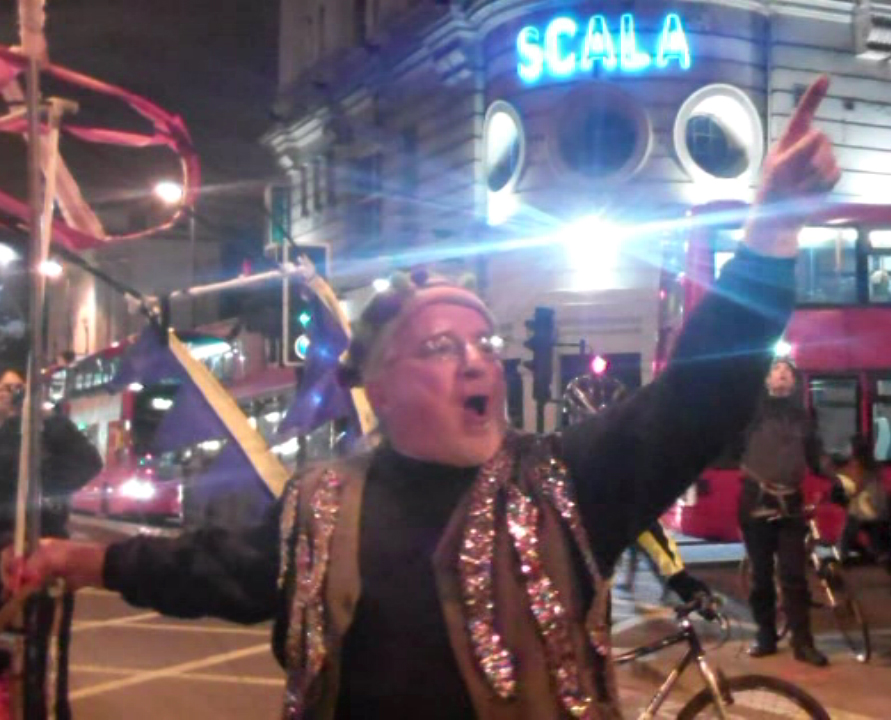
Last night’s go slow demo organised by Bikes Alive ended on a high point with Des, the cycling poet from the London Critical Mass rides, giving a fantastic performance at the junction of the Cally Road, Pentonville Road and King’s Cross Bridge. The crowd adored it and our police officers had a ball too. It was a lovely evening with the local community and the London-wide cycling community joining together to call for real road safety measures for King’s Cross.

(Video of the cycling poet)

Posted in Arts and Entertainment, King's Cross People, Road Safety in Kings Cross | Tagged , , , , , , , , | 8 Comments

A taste of freedom for cyclists and pedestrians on KX roads

Traffic stopped at KX at the height of rush hour last night when hundreds of cyclists and pedestrians staged an hour long ‘go slow’ to highlight the appalling design of the King’s Cross gyratory system.

The rush hour protest was spearheaded by Bikes Alive and may prove to be the first of a series. It was an inspiring experience to witness the entire gyratory filled with people cycling and walking – a vision of how roads could be if only they were designed for different types of road user instead of being designed solely for motor vehicles with everyone else expected to take their chances. Even the imminent ‘improvement’ works planned for the gyratory could end up making it worse.

Earlier yesterday, Boris Johnson, Mayor of London was accused of acting negligently since Transport for London (TfL) introduced its own safety standards in 2005.

Additionally, TfL may be guilty of corporate manslaughter after its repeated failure to act on calls by its own consultants to redesign the traffic system at King’s Cross resulted in the death last year of Deep Lee (Min Joo Lee).

Motorists (including cab drivers), pedestrians and cyclists have long called for removal of the one way system at King’s Cross. Redevelopment works here that started many years ago would have been the ideal opportunity to redesign the area. This would have made it safe and given the entire neighbourhood a much needed boost. Exactly as has been experienced in many other once ‘rough’ neighbourhoods that were home to one way systems –  recognised for dragging communities down and creating no-go areas.

Posted in Bad Gyrations KX Campaign, Road Safety in Kings Cross | Tagged , , , , , , , , , , , , | 4 Comments

TfL improvements may make things worse

Click on the drawing to enlarge it

Works currently being carried out to the junction where 24 year old Central St Martin’s design student Deep Lee (Min Joo Lee) met her death last year may make things worse. (TfL’s improvement works shown left.)

Recognised by cyclists and pedestrians alike as the worst section of a dangerous and complicated junction, moving from Gray’s Inn Road to York Way when going north the route that most needs more safety measures may end up with less.

There is no provision for a cycle lane here or anywhere else on the junction. Without this, widening the Gray’s Inn Road to York Way section will provide vehicles with two lanes and no designated safe space for cyclists. This is definately not an improvement for any users apart from motor vehicles – in line with the Mayor and TfL’s police of ‘smoothing’ traffic – forcing more motor vehicles through London’s roads in less time.

Camden Cyclists, part of the London Cycling Campaign, have long campaigned for improvements here and continue to highlight the shortcomings of new works such as this.

Protesters meet at 6pm tonight at this junction to force traffic to go slow. They aim to highlight the need for safety measures, not smoothing measures, to take place.

Posted in Road Safety in Kings Cross | Tagged , , , , , , , , , | 7 Comments

Jenny Jones to join in direct action on junction tomorrow

Big attendance at the Kings Cross Christmas VigilThe Green Party London Assembly Member is to unite with cyclists in King’s Cross on Monday (9 January) for a ‘go slow’ around the gyratory during the evening rush hour.

A statement from the organisers, Bikes Alive:

Jenny Jones, Green Party leader at the Greater London Authority, has announced that she is joining a cyclists’ direct action event at King’s Cross on Monday. The event, initiated by cycling campaign group Bikes Alive, is to demand a change in the balance of power on London’s roads and an end to the official policy of giving priority to the speed and volume of motor vehicles above the safety and sanity of everyone else.

Jenny Jones said, “London’s roads must be fixed urgently if we are to make them safe for cyclists and all other road users. This is the Mayor’s responsibility, and I hope that if we make a statement through peaceful, direct action he will start to listen.”

Bikes Alive has called for cyclists and pedestrians to take active steps to calm the traffic outside King’s Cross station from 6pm to 7pm on Monday, if possible by closing the road to motor vehicles completely.

Disability campaigners’ support
The priority given to motor traffic affects pedestrians, as well as cyclists, and Bikes Alive demands changes which would improve the safety of all slow-moving and vulnerable road users, including the re-timing of traffic lights at junctions and crossings to allow much longer periods between successive green-for-traffic phases.

Lianna Etkind of Transport for All (which campaigns for safe and accessible means of travel for everyone, irrespective of their abilities or disabilities) has also spoken out in support of the demonstration, and will be present with other Transport for All activists. She said, “The Mayor’s insidious talk of ‘smoothing traffic flow’ covers an agenda of prioritising impatient motorists over the safety of pedestrians. Disabled and older people’s safety and independence is being put at risk by shortsighted streetscene policies, particularly the removal of crossings.”

Bring your dancing shoes
Bikes Alive was set up in reaction to the almost hysterical support, in many circles, for the divine right of motorists to delay, poison and terrorise cyclists and other non-motorised road users.

Albert Beale, speaking on behalf of Bikes Alive, said today, “Monday’s event is the first step in a campaign to stop – by whatever non-violent means needed – the completely unnecessary level of deaths, injuries and fear inflicted by motorists on the more vulnerable. I urge cyclists to join us on Monday. And if you don’t have a bike, bring your dancing shoes…”

Posted in Bad Gyrations KX Campaign, Road Safety in Kings Cross | 12 Comments

Why did TfL’s killer Kings Cross junction not measure up to TfL’s own London Cycle Design Standards?

This site has covered closely over the years TfL’s killer junctions in Kings Cross.  We have several dozen testimonies of people’s day to day experiences.  The recent death of cyclist ‘Deep’ Lee at the junction of Grays Inn Road and York Way despite explicit warnings to TfL of severe problems at the junction led me to suggest that the police should examine whether TfL is liable under the Corporate Manslaughter and Homicide Act. TfL have largely  ignored warnings and persisted over many years with basic design failures at that junction.

TfL is about to remodel the junction so I paid it one last visit to the bottom of York Way to try to understand why that junction is so deadly.

Armed with a Stanley Surveyors Tape from Franchi I measured the roads during red light stops.  In an entirely non scientific process I tied the tape off to a bit a street furniture close to the kerb, scampered across the road, read the mark at the opposite kerb then subtracted the figure where the tied end crossed the kerb.  This is accurate to within a few centimetres, if anyone has a theodolite please feel free to repeat this to millimetric accuracy.

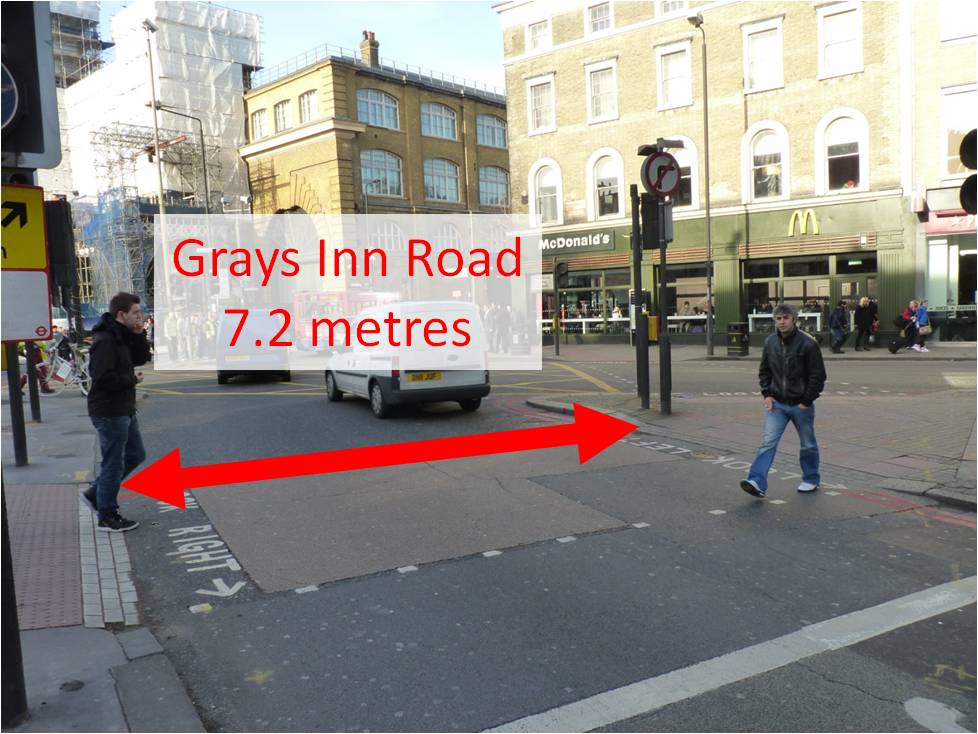
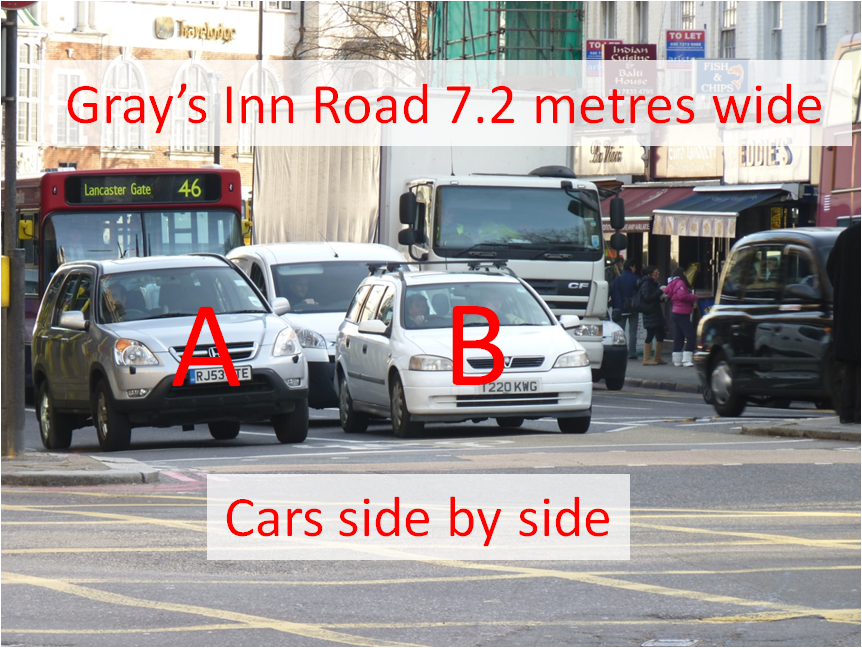
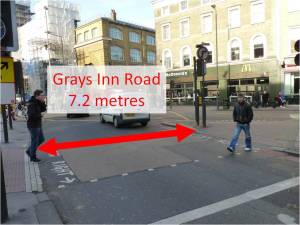
Grays Inn Road (two lanes of traffic) is 7.2 metres wide at the pinch point.
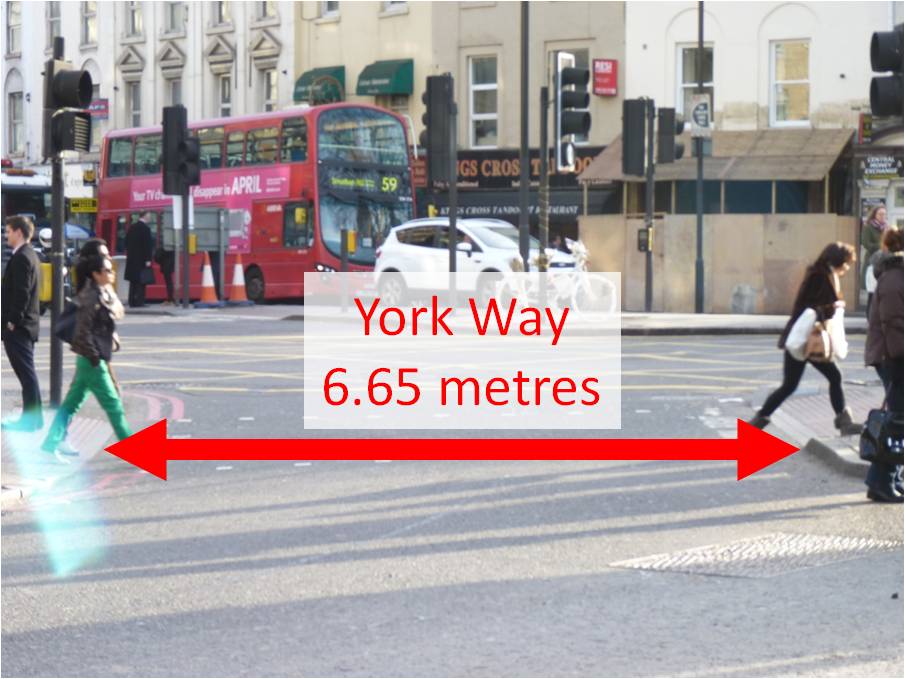
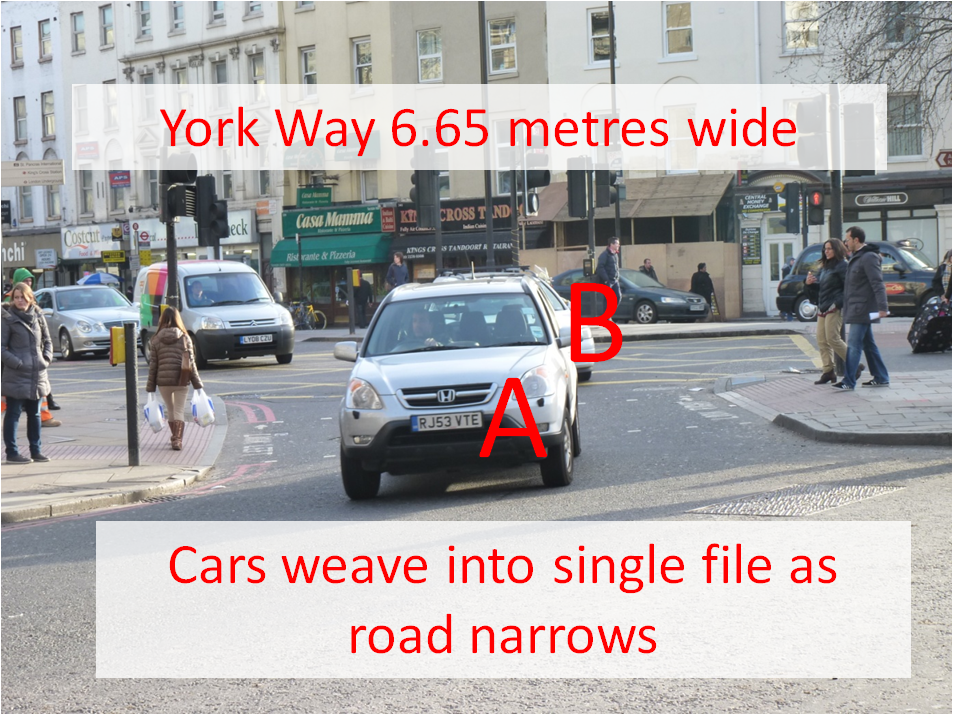
York Way is only 6.65 metres wide, the road narrows as you ride or drive across the junction
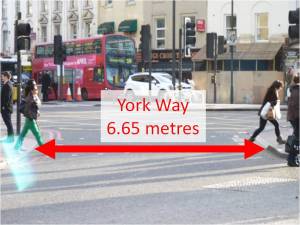
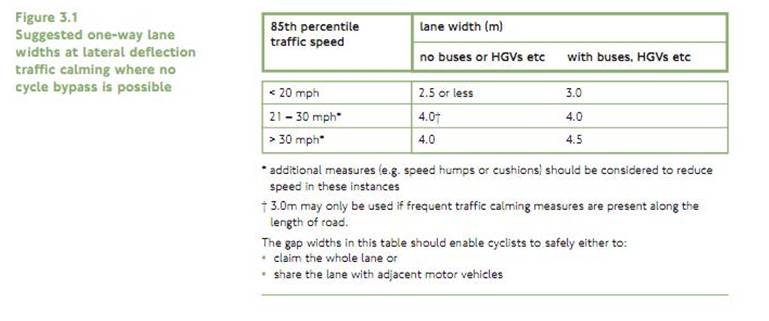
But TfL’s own guidance (see below) says that this type of road should be 8 to 8.5 metres wide  – the junction is almost two metres too narrow at the York Way end and almost 1.5 metres too narrow on Grays Inn Road.

So on Grays Inn Road two cars can more or less fit side by side

But crossing from Grays Inn Road to York Way traffic faces a 60 degree right turn as well as a road narrowing. This causes the two lane traffic to weave together into one lane as the two cars A and B demonstrate in the pictures.
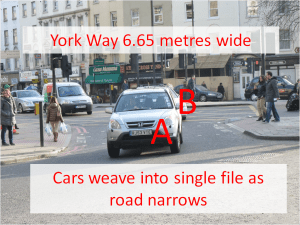
This is really tough to deal with when you are on a bike.  For Deep Lee it was deadly as she sought to find her own space on the road (the police showed me  and local Councillors the harrowing footage when they asked me in to discuss the investigation).  A narrowing twisting road like this is known as a chicane.

TfL’s own technical guidance sets out standards for such pinch points:

TfL London Cycling Design Standards Chapter 3, page 58, section 3.6.4

Chicanes and pinch-points
3.6.4
It is important to ensure that the feature is designed in such a way that cyclists are neither squeezed nor intimidated. Options include:

• raising driver-awareness of cyclists with an advisory cycle lane (with or without coloured surfacing) and cycle-symbol road markings through the pinch point
• providing a clear one-way width in accordance with figure 3.1
• a cycle bypass that allows cyclists to travel past the obstruction without losing priority or having to ‘give way’.

Figure 3.1 page 58 goes on to set out lane widths that increase with traffic speed and weight of traffic. This is a fast two lane junction with construction HGVs and buses constantly running through it:

Figure 3.1 says: …with buses, HGVs etc….<21-30 mph, 4.0 metres [wide]…>30 mph 4.5 metres [wide]

So for two lanes of traffic the road should be at least 8.0 and preferably 8.5 metres wide according to TfL’s own guidance at the prevailing speed limit.  The road at this junction is at its narrowest 6.65 metres according to my amateur measurements.

TfL with  the vast resources available to it has been managing a junction for years that does not comply with its own design guidelines, despite stark warnings about safety in reports TfL itself commissioned.  This reinforces my calls for a proper investigation of TfL under the Corporate Manslaughter and Homicide Act – in the face of clear evidence about danger the dysfunctional bureaucracy has failed to take adequate action in a timely manner, leading, in my view to death.

There is strong public interest in understanding how such bureaucratic dysfunction has come about in order that we can ensure it doesn’t happen again.  It would be great if Caroline Pidgeon as Chair of the GLA Transport Committee could ask the Mayor and his Transport Commissioner whether the York Way/Pentonville Road/Grays Inn Road junction complies with TfL’s  London Cycling Design Standards with regards to lane/carriageway width, if it does not when TfL first became aware of this non-compliance, what correspondence TfL has had with the Met Police about the compliance of this junction, why TfL has failed to act to make the junction compliant with its own standards, which officers are responsible, which other major junctions do not comply with TfL’s own Cycling Design Standards, when non-compliant junctions will be rectified  etc etc

TfL’s belated plans to widen the junction appear only to have emerged thanks to arm twisting by the Olympics Delivery Authority, and these plans are mired in controversy.  Behind the scenes our excellent local Councillors Convery (Islington, Lab) and Braithewaite (Camden, LibDem) are both pressing TfL hard to consult locally and implement plans that work for cyclists.  The brilliant Sophie Talbot has enlisted Councillors and GLA members to track down the latest plans TfL engineers are working from, but we can’t even get hold of them.  It’s a sorry state of affairs.

Posted in Road Safety in Kings Cross | 16 Comments

Black-Cab Drivers and idling engines at Kings Cross / St. Pancras

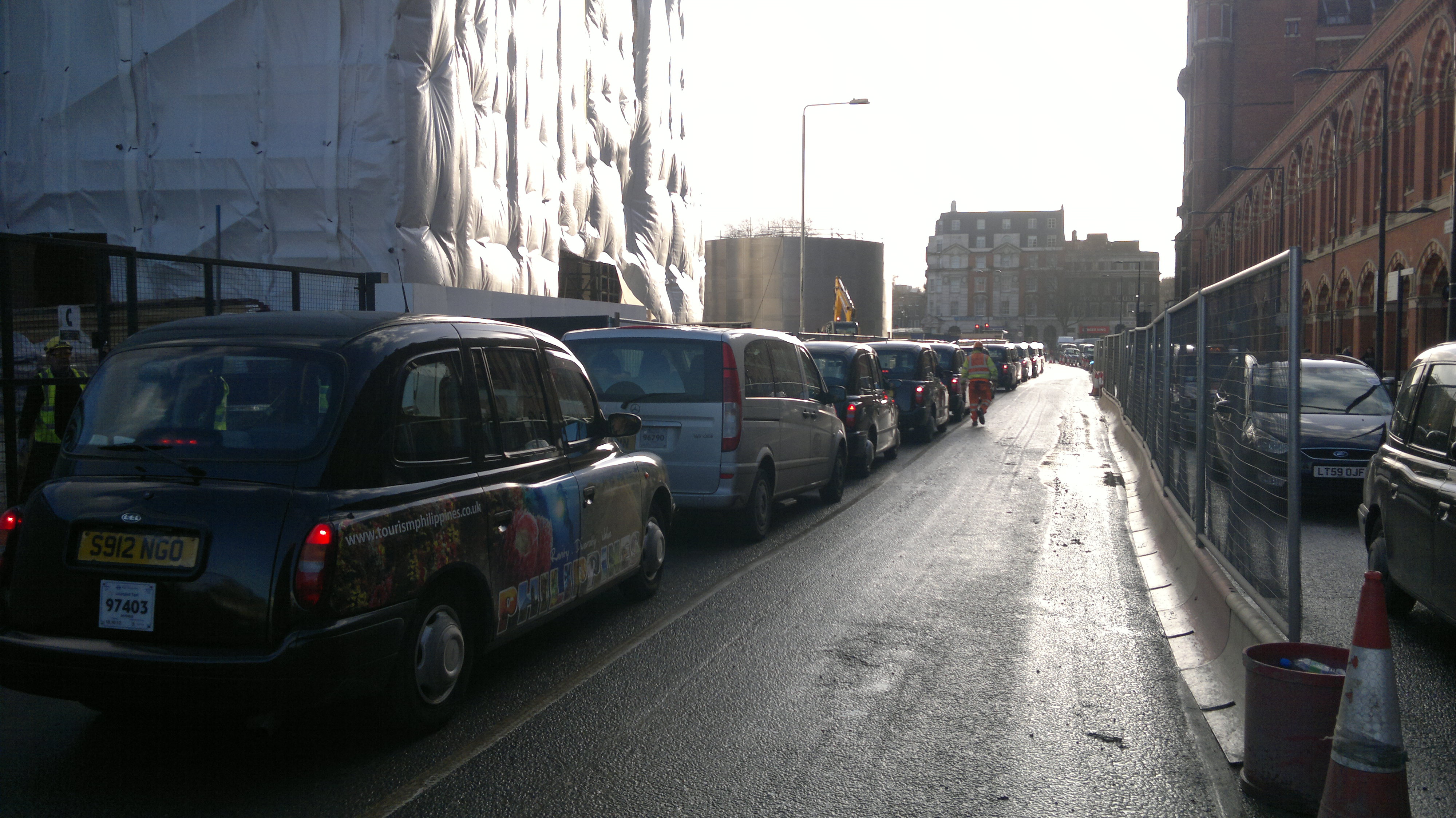
All of these waiting cabs and about 10 more behind me had their engines running this morning.  They advanced a few meters at a time.

Some time ago this point was already raised on Kings Cross Local  noting that black-cabs with running engines queued as far as Goods Way.

I would like to know if it is possible to manage advance of cabs better than meter by meter which require engines to be kept running.   Here is a suggestion:  If progress to the pick-up points would be in threes or fours, that is a cab advances every time three or four vehicles in front have moved, rather than the bumper to bumper advances we observe at the moment, it would allow the switching off of engines, and as a result a slight lowering of emissions. A little bit of paint on the roads creating painted queuing boxes for three or four cabs behind each other alongside the full queuing stretch either up to the German Gymnasium or up to Goods Way and a few signs explaining the system is all that would be needed.  Only in the last box where passengers are picked up running engines should be allowed.

Here is an illustration:

Goods Way/1234/1234/…../ 1234/1234/1234 /pick up point / Euston Road

During the air quality summit at Camden Town Hall last year it was highlighted that the emissions from black cabs constitute a high percentage of the overall traffic emissions.  Whilst changes on engine technology here are one issue, a little bit of management of the queuing system can achieve a lowering of emissions at Kings Cross / St Pancras at ease.

On the topic of idling engines London mayor Boris Johnson announced last year that he would introduce fines for keeping engines running (see Evening Standard here).

Posted in Community Health and Welfare, Transport | 18 Comments