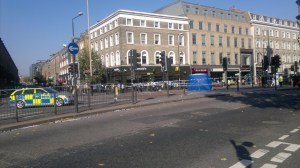
 In October 2011 a young woman cyclist was killed at a junction in Kings Cross managed by TfL. TfL was aware that the junction was dangerous following a report TfL itself commissioned. TfL was also aware that the junction did not comply with its own London Cycle Design Standards. Yet TfL had not implemented a junction redesign in a timely way nor applied a basic precautionary principle and modified traffic flows there pending work. I believe that TfL has questions to answer about being in breach of its basic duty of care and should be investigated for corporate manslaughter. I have raised this with the police who are investigating the cyclists death.
Since I first wrote about this topic I have received strong support from the local Kings Cross community, the London cycling community and elected representatives. The cyclists have made me aware of far wider issues with TfL’s approach to cycling and junctions in London. As a former bureaucrat myself I am startled at TfL’s practice in respect of receiving warnings about threats to human life and apparently not then acting promptly and effectively. Of course, no road junction can be 100% safe, trade-offs have to be made in public policy, but TfL seems to have no reasonable system to do so and is to my mind in breach of its duty of care to road users.
This blog post rounds up my own views on some headline issues that would need to be looked at in a corporate manslaughter investigation. Issues are expressed as headlines only, sometimes going beyond Kings Cross. I may well be wrong on some of these points, indeed in many ways I hope I am but they reflect views put to me. Please add more or give your views in the comments, in the usual measured, non-partisan way that people choose to use this blog.
TfL context
TfL was created in 2000 and is a well-established, mature bureaucracy with comprehensive information about London’s road network and a substantial body of information on cycle and pedestrian safety. TfL is a very large organisation that performs a complex set of tasks to fulfil a wide range of objectives.
TfL owes a duty of care to members of the public who use its facilities such as road junctions. Given the complexity of TfL’s tasks a consistent, measured, timely approach is vital to delivering that duty of care. Decisions on safety of life must be taken with well thought through methodologies, consistently applied. The framework within which TfL makes decisions about safety is in part set by the incumbent Mayors policy – indeed, in TfL’s own words:
‘Its main role is to implement the Mayor’s Transport Strategy for London and manage transport services across the Capital for which the Mayor has responsibility.’
Strategy failure?
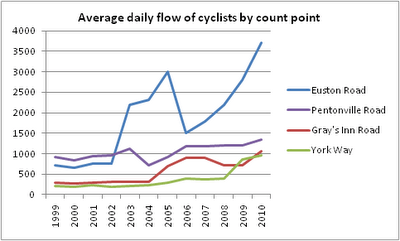 The explosive growth in cycling in the Euston Road, Pentonville Road, York Way area, far beyond the growth of any other of TfL’s transport modes and puts a special burden on TfL to act strategically, based on evidence with regard to cyclists. A complex set of junctions designed for cars 20 years ago is highly unlikely to absorb this growth in cycling safely. The Euston Road is notorious for its aggressive road conditions even amongst car drivers and has few workable alternatives for cyclists – you have to cross it or use it. The growth in cycling numbers on DfT data is extraordinary – yet TfL has not made a large scale strategic intervention in cycling conditions at the Kings Cross junctions. TfL’s strategic approach and actions appear to have failed.
Failure to act on breach of TfL’s own London cycle Design Standards?
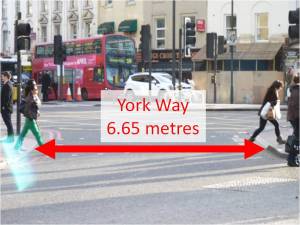 Grays Inn road and York Way junctions both breach TfL’s own London Cycle Design Standards. I have seen the CCTV footage and in my view, the need to compete for space on Grays Inn Road was a factor in Deep Lee’s death. TfL went to great lengths to create cycle design standards for London – a pattern book of ways in which one should build a road to make it cycle safe and friendly – the document stretches to hundreds of pages. Yet TfL has chosen for years to ignore these standards at Kings Cross and we suspect a number of other junctions. Peter Hendy, now Transport Commissioner was a strong supporter of the LCDS in 2005 as his letter shows. The London Cycle Safety Action Plan does not suggest that TfL should systematically make its high risk junctions compliant with the LCDS. Given that TfL has had plans of the junction in its possession for some time how could it let the junction persist in that state?
Failure in balancing ‘smoothing traffic flow’ and safety of life for cyclists and pedestrians?
A separate cycle lane on Grays Inn Road would comply with the Cycle Design Standards yet TfL cite the Mayor’s ‘smoothing traffic flow‘ policy as a reason not to implement a cycle lane there. That is to say, a cycle lane would make the road much safer for cyclists but would reduce the throughput of cars at the junction – the throughput of cars wins over cycle safety. This trade-off rears its head again and again. Yet we have no insight into how it has this been evaluated – how does a minor inconvenience to traffic outweigh a fatally poor design. What cost benefit evaluation has been used? Given TfL’s strong engineering tradition there must be a simple mathematical formula used to make this calculation consistently across the network. The UK is a world leader in these forms of appraisal but TfL never reveals its workings.
‘Smoothing traffic flow’ has featured prominently in the Mayor’s policy document since ‘Way To Go’ in 2008 and is enshrined in his full transport strategy. Feedback from cycling organisations and elected representatives suggest that this policy is frequently cited as a reason not to make improvements to road junctions that increase cycle safety. The implementation of this policy, which is intended to benefit cyclists too has failed and the policy has been mis-applied diminishing cycle safety.
Failure to act in a timely manner?
TFL is remarkably slow to act when a serious safety hazard is brought to its attention. In Kings Cross, residents have been campaigning for years about the dangerous junctions. A TfL spokesman on BBC TV news when asked about the time it had taken to do necessary work there said:
‘For the nature of the type of work we are doing three years is a pretty sort of typical time..’
There seems to be no sense of real-world proportionality here. In three years an entire Olympic village has arisen in East London.
Failure to adopt the precautionary principle while awaiting action?
If a cyclist gets mown down at a junction where you have been told that ‘casualties are inevitable’ in one of your own reports a common sense approach would be to restrict or close that junction until you can put in place hard engineering measures to prevent the problem happening again. The precautionary principle is well established in professional practice and would be expected in a duty of care when operating dangerous systems. See for instance airlines and the volcanic ash cloud etc. Yet TfL repeatedly seems to hose the blood away and reopen the road as quickly as possible without taking precautions to understand what has happened and put in place temporary measures to guard against potential repetition.
Failure in consistency of approach?
To deliver a duty of care some consistency is required over time – TfL’s sporadic changes of position on whether junctions do or don’t need work indicate the lack of a consistent, robust methodology for evaluation human safety considerations against others. TfL and the Mayor in May 2011 seemed adamant that the priority at the Bow roundabout was traffic flow:
‘TfL have been unable so far to find an immediate solution for providing controlled at-grade pedestrian crossings at Bow Roundabout that does not push the junction over capacity and introduce significant delays to traffic.’
In October 2011 the Mayor met with the family of a man who was killed at Bow and then in January 2012 to the huge surprise of the cycling community TfL has brought forward comprehensive plans for Bow with a very short consultation time, as if the work is being done in a rush. So within TfL what has changed – there can be little or no new information, why was their viewpoint held for many years so suddenly changed. Was their earlier work flawed or incompetent? Is the fact that TfL now admit that work is required in the face of earlier inaction actually an admission that they were in breach of their duty of care?
It seems that one minute the junction is fine according to TfL then the next minute it’s having hundreds of thousands of pounds thrown at it. The very cautious wording TfL uses in its announcements about junctions always being ‘under review’ suggests to me that they know they have a problem. This suggests to me that there is a breakdown between policy and implementation leading to a failure of a duty of care.
Systemic failure of bureacracy?
The points listed above cannot be sporadic failures by lone operators. In a bureaucracy such as TfL information will be passed around, up and down command chains to and from the Mayor’s office and widely disseminated, the media are all over the issues . The responsibility is shared throughout the organisation. In too many instances, the bureaucracy as a whole, TfL’s ‘controlling mind’ has failed with respect to the duty of care owed to cyclists that use TfL’s major road junctions. I puzzle over how the Mayor can on the one hand profess to care deeply about cycle safety (he is after all an ardent cyclist) and on the other direct and control a TfL that appears to be in breach of its duty of care towards cyclists at deadly junctions it controls. The Mayor and his Transport Commissioner are in charge of TfL, well aware of the issues around cycle safety and must bear some culpability.
This list is incomplete and very much a brain dump from me. Any further suggestions, clarifications or comments are welcome below in a constructive, on-topic, non-partisan manner.
51.531133
-0.122324
 In Britannia Street at least. Gagosian Gallery has opened an exhibition of Damien Hirst’s dot paintings: The Complete Spot Paintings 1986–2011.
 Frustration at continued lack of action by Transport for London to ensure the safety of all road users across London resulted in a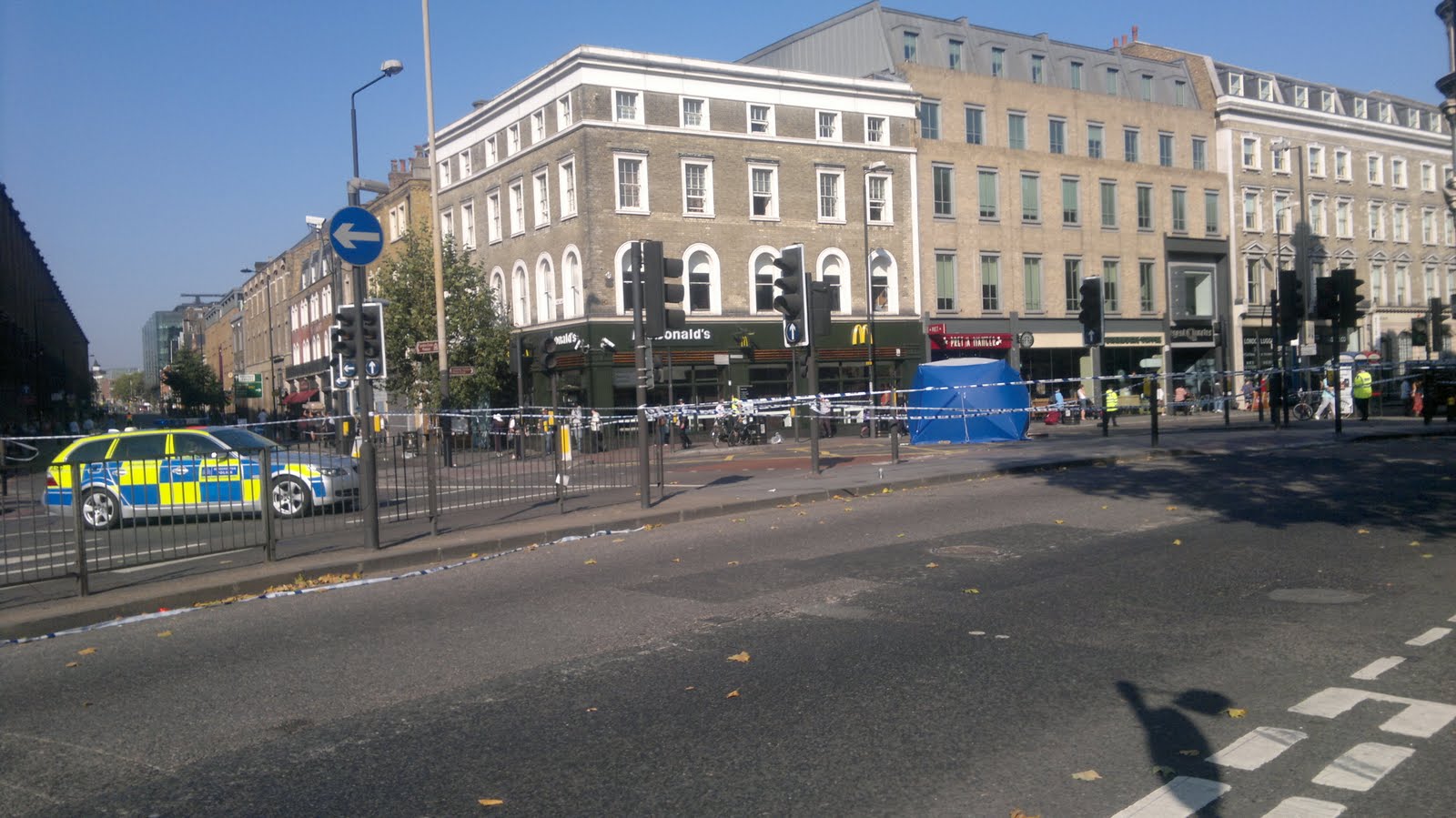


 Kings Cross Environment