Bringing the new Kings Cross Departure Boards to life – that Solari Board sound

When you follow a search for Kings Cross on twitter you get all sorts of things – party people in Kings Cross Sydney Australia, people heading for Water Rats, trying to find Kings Place, arranging to meet at Nandos, berating the railways, even the odd sex worker.  This tweet made me think a minute:

@wixy699 I miss the ticky tacky departure board in kings cross 😦

Nick as @wixy699 is known is talking about what Wikipedia tells me is called a ‘split flap display‘ or a Solari Board, after the Italian manufacturers, that made a comforting noise when they changed.  There’s a nostalgic video with sound of one in Newark NJ below:

The new Kings Cross concourse in the glass blister will have the functional but anodyne orange LED display boards.  The big problem with these is that they are silent – you never know when something has changed so you have to keep a close eye on them.  At Paddington in particular there are crowds of people standing motionless staring at the boards – in the chaos of the evening rush hour you dare not miss a beat as the trains are posted late and leave within  a minute or two.  The old Solari boards though gave you an audio clue of when to turn and look.

Kings Cross has a particular problem with trains turning around so fast they are hard to catch.  The new boarding arrangements will make it a long hike to platforms 2,1 and 0 and there will be some of the Clapham Junction stampede as passengers herd frantically over the bridge.  I wonder if Network Rail could add the gentle ‘ticky tacky’ sound of the departure boards changing over the PA?  It would also allow people to spend more time in shops and restaurants – rather than milling in the concourse staring at screens.

Posted in Kings Cross Station Refurbishment | 2 Comments

Should there be an official neighbourhood forum for KIng’s Cross?

Under the Localism Act, a neighbourhood such as the King’s Cross area can have a neighbourhood forum that creates a neighbourhood development plan (and neighbourhood development orders) for approval by the local authorities and an independent inspector. In principle, then, people get extra ways of influencing how their neighbourhoods should develop, provided that they are consistent with broader London and borough plans.

Would a neighbourhood forum be effective in the King’s Cross area? If so, how should it be set up? These are very important questions for the King’s Cross community. They will be central to the meeting of the King’s Cross Development Forum on 9 February. Organisations like the King’s Cross Development Forum have four possible courses of action:

  • Seeking to form the core of a neighbourhood forum.
  • Working towards the formation of a neighbourhood forum as a new organisation.
  • Working with a neighbourhood forum if it is formed by a different organisation.
  • Regarding the formation of a neighbourhood forum as an irrelevant distraction.

To provide background information, Forum members have provided a note on the framework and a view of the implications. There is also a large quantity of material from the Department of Communities and Local Government here; it is supplemented by Camden Council here.

A neighbourhood development plan can cross borough boundaries. Something similar is now recognised in the Council exercise on “Shaping the Future of the King’s Cross Area”. This was originally set up by, and confined to, Camden, but is now being extended to Islington (as the Forum said here that it should be, in 2010). Its final results are now due out in the middle of 2012.

The Forum meeting will also look at the use of the Section 106 funds from the King’s Cross Central and King’s Cross Station developments. It will be from 7:00 to 9:00 on Thursday 9 February in Committee Room 2 of Camden Town Hall.

Posted in Community groups, Noticeboard, Planning, Licensing and Regulation | Leave a comment

TfL panicked into review of junctions that it’s mismanaged for a decade #cyclesafe

TfL has launched a panicky review of major junctions across London in response to overwhelming pressure from cyclists, local politicians and media outlets.  As part of this review, TfL has admitted that some junctions are ‘challenging’ for cyclists.  TfL says:

We’re reviewing cycle safety at all junctions on Barclays Cycle Superhighways and major junctions on the Transport for London Road Network (TLRN).

The review supports our other cycle safety initiatives, including our cycle safety action plan and work with HGV drivers.
Which junctions will be reviewed?

We’ll review all junctions on the existing Barclays Cycle Superhighways (routes 2, 3, 7 and 8), focusing on 50 key locations.

We also plan to review 150 major junctions on the TLRN. The majority of these are locations where work is already planned and is being designed.

Additionally, we’re looking at a small number of junctions where no scheme is planned, but where it is felt that there are particular challenges for cyclists.

So why is this review panicky? Firstly TfL admits that some of its junctions present

‘particular challenges for cyclists’

This is an amazing admission – TfL has been in charge of these junctions for about ten years during which time there has been an explosion in cycling.  Yet, despite TfL’s loving engineering and safety culture the junctions remain challenging for cyclists.  To my mind this is a prima facie admission of a breach of TfL’s duty of care to people who use its roads.

Secondly, only in November last year the Chair of TfL (Mr Alexander Boris de Pfeffel Johnson, also Mayor) in the Assembly was firm that engineering solutions, remodelling junctions and putting in specific cycle lanes were largely not the answer in the exchange below with Caroline Pidgeon (AM) –

You have got to be honest and sometimes, Caroline, it is not the case that you could materially affect the outcome by engineering. You have got to be honest about this. You cannot just tell people that it can all be magically changed simply by rebuilding roads

And third, in the same exchange in the Assembly the Chair of TfL says that junctions ‘are under constant review

So what’s going on here? TfL already has these junctions under constant review, their Chair has said so – where are the results of this constant review?  Why is another review needed? Why, when the junctions are under ‘constant review’, has TfL admitted that the junctions remain challenging for cyclists (in one tragi-comic instance the TfL cycling superhighway review team went to Archway and refused to ride around it, dismounting and pushing instead)?

Overall this review shows a bureaucracy on the run, terrified that they are to be held to account by the media and the courts.  But there is one team that comes out of this winning – the TfL PR team they’ve done a magnificent job of suckering The Times into seeing this as a victory for their #cyclesafe campaign as London leads the way, rather than the shabby cover up of a decade of mismanagement.

That Pidgeon/Johnson exchange in full below, for more see our earlier post.

Caroline Pidgeon (AM): Yes, but what I am asking is will you commit to make sure you review these junctions personally and particularly the cycle superhighways. A lot of cyclists that I talk to see it as just some blue paint on the road and at some of the very difficult junctions – whether it is Oval or Stockwell – you have not really tackled some of the more expensive mechanics that you need to make at those junctions to make them work and safe for cyclists.

Boris Johnson (Chair, TfL): Of course. That is why –

Caroline Pidgeon (AM): Of course – is that a yes?

Boris Johnson (Chair, TfL): They are under constant review and I can tell you that I personally cycled all of these areas and I have strong views –

Caroline Pidgeon (AM): And reviewed them?

Boris Johnson (Chair, TfL): — about them. I make my views known to TfL. You have got to be honest and sometimes, Caroline, it is not the case that you could materially affect the outcome by engineering. You have got to be honest about this. You cannot just tell people that it can all be magically changed simply by rebuilding roads –

Caroline Pidgeon (AM): It is not just engineering – it goes along with training and some of the other measures from HGVs that I welcome. I still want you to be reviewing those dangerous junctions to make sure you are doing everything you can.


Posted in Road Safety in Kings Cross | 2 Comments

Leon Kings Cross to open next month

Pic - Jayme Frye aka Allie's.Dad Flickr, ccMy favourite convenience food chain Leon is to open in the new Kings Cross station glass blister next month, 18 March according to the FT. Leon has gone into partnership with HMSHost to extend the Leon footprint as a franchise.  Let’s hope they keep a tight grip on quality control – I’ve always found Leon’s food to be excellent.  Leon’s partner runs motorway service stations and airport food outlets in the USA and they have hired a former Burger King executive but I’ll judge it in the eating – might speed service up.

Posted in Food and Drink | Leave a comment

Are you interested in the Canal?

Friends of Regent’s Canal

Public Meeting

Find out what is happening on your canal and how you can get involved.

If you are interested in meeting local residents and organisations that are involved in promoting and protecting the canal, or if you want to hear about canal closures, litter and other problems, then come along to the next meeting of the Friends of Regent’s Canal.

Wednesday 15th February 2012

7pm to 9pm

at the London Canal Museum

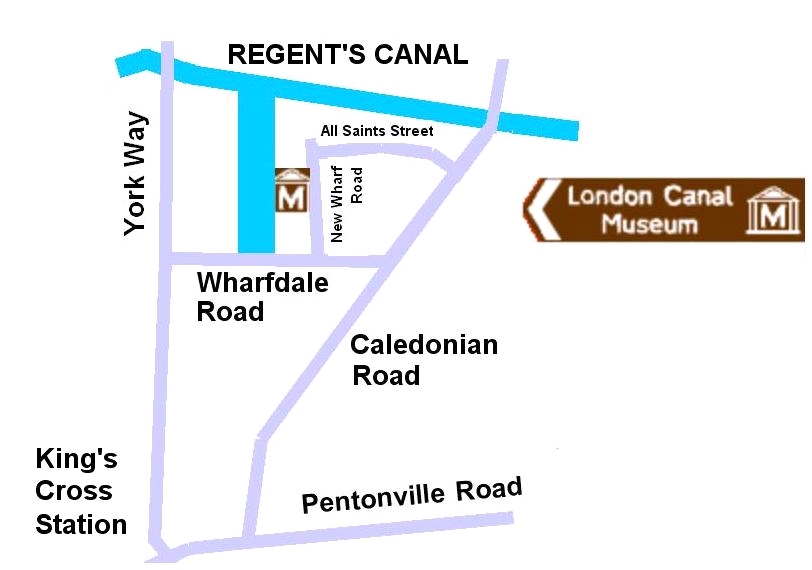
London Canal Museum, 12-13 New Wharf Road, N1 9RT (near King’s Cross)

For more information visit our website www.friendsofregentscanal.org
or send an e-mail to friendsregentscanal@gmail.com
or telephone 079 8059 9854.

Posted in Community groups, Noticeboard | Tagged | Leave a comment

‘It grieves me sometimes to see the way that TfL is blamed’ Chair of TfL, Boris Johnson

As part of our public service commitment  I have dug out the debate in the Greater London Assembly on cycling safety on  November 9th 2011 so that we can see what politicians of all parties said before a major media campaign burst out from The Times.  This debate went under the guise of questions to TfL.  I am grateful to our colleagues at Camden New Journal for first reporting this at the time – I admire the fact that the Journal still does things the old fashioned way and goes to stuff and reports it.

Anyway, the transcript of the debate is hidden away inaccessibly on the London.gov.uk website so I have extracted the bit on cycling verbatim and put it in an easy to browse google doc – anyone can see it you don’t need an account or login.  You can also download it as a word document here.  The Chair of TfL (Boris Johnson, also the Mayor)  puts in a bravura defence of TfL and ducks and dives all over the place on whether junctions should be re-engineered to make them safer for cyclists. Mr Johnson’s statement that junctions are ‘under constant review’ is fascinating – if they are under constant review why is so little timely action taken to make them safer?  Some of his sweeping comments about engineering solutions to make the road safer beggar belief as you ride through Kings Cross.  Thanks to Caroline Pidgeon AM and Jenny Jones AM for pushing hard.

Boris Johnson (Chair, TfL): When you look at some of these roundabouts, for instance, it is simply not possible to put in a dedicated lane that would protect a cyclist in the way that we would all want without totally disrupting the traffic…..

Caroline Pidgeon (AM): Yes, but what I am asking is will you commit to make sure you review these junctions personally and particularly the cycle superhighways. A lot of cyclists that I talk to see it as just some blue paint on the road and at some of the very difficult junctions – whether it is Oval or Stockwell – you have not really tackled some of the more expensive mechanics that you need to make at those junctions to make them work and safe for cyclists.

Boris Johnson (Chair, TfL): Of course. That is why —

Caroline Pidgeon (AM): Of course – is that a yes?

Boris Johnson (Chair, TfL): They are under constant review and I can tell you that I personally cycled all of these areas and I have strong views —

Caroline Pidgeon (AM): And reviewed them?

Boris Johnson (Chair, TfL): — about them. I make my views known to TfL. You have got to be honest and sometimes, Caroline, it is not the case that you could materially affect the outcome by engineering. You have got to be honest about this. You cannot just tell people that it can all be magically changed simply by rebuilding roads —

Caroline Pidgeon (AM): It is not just engineering – it goes along with training and some of the other measures from HGVs that I welcome. I still want you to be reviewing those dangerous junctions to make sure you are doing everything you can.

Jenny Jones (AM): Commissioner, thank you for your letter that you have written to me about the Kings Cross cycling death. You have offered a briefing on the whole junction which probably Val Shawcross and Caroline Pidgeon would also like to be part of. Yes, to that briefing.

Boris Johnson (Chair, TfL):  …Jenny, I really respectfully appreciate you raising this up the agenda because I take this incredibly seriously and it is of huge personal importance to me because I feel that I am the Mayor who makes a big thing about cycling and goes on and on about how wonderful it is that we have got our bike hire scheme and that we have had a 15% increase in cycling in the last year.  I am very proud of it so of course it really worries me when I read about cycling accidents.  It grieves me sometimes to see the way that TfL is blamed.  If we can do anything to ameliorate the junction that you describe, or the roundabout, and if that would really address the problem then of course we will look at it.  Sometimes I do not think that physical street works are the answer.  The answer is, very often,  to educate HGV drivers and to educate cyclists about the need not to be, as I said in my earlier answer to Caroline, caught in that position on the left.

Posted in Road Safety in Kings Cross | 2 Comments

TfL refuses to say why it didn’t act to make deadly junction comply with their own cycle design standards

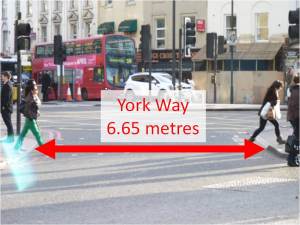
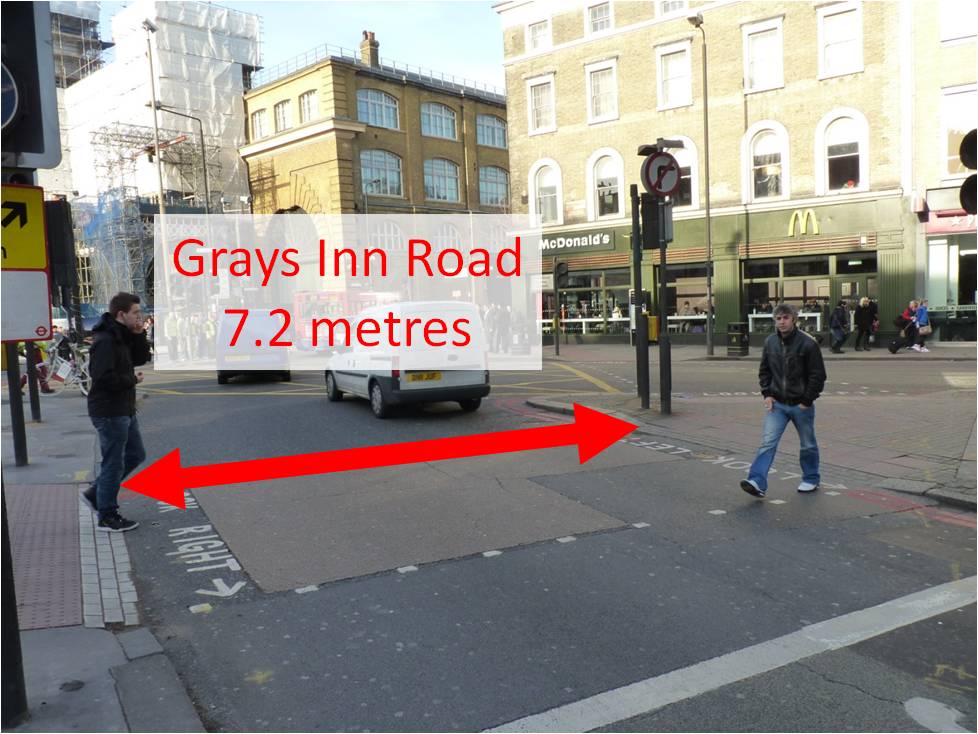
Caroline Pidgeon AM (Lib Dem) Chair of the Transport Committee has been asking some probing questions of the Mayor and TfL about the deadly junctions in Kings Cross following work by this website when I went out with a surveyors tape and measured the roads. I am most grateful to her.

It’s pretty clear from the Mayor’s answers  below that TfL admits that the York Way/Pentonville Road/Grays Inn Road junction does not comply with their own safety standards for cyclists. They also refuse to say why they did not act to make the junction compliant earlier.  These standard have been around for over 5 years and TfL has done nothing to make the junction comply.

TfL also seems to be on the run on its ‘review’ of junctions, eliding work on the blue lane superhighways with ‘other major junctions on the TLRN where work is planned’.  So in TfL’s own words if no work is planned on your local junction and it isn’t compliant with TfL’s cycle design standards then it’s just going to stay that way.


Mayor’s Questions – 25th January 2012

Junction at King’s Cross (1)

Question No: 313 / 2012

Caroline Pidgeon

Does the York Way/Pentonville Road/Grays Inn Road junction comply with TfL’s 2005 London Cycling Design Standards with regards to lane and carriageway width?

Written response from the Mayor

The London Cycling Design Standards 2005 (LCDS) is a best practice guidance document intended to ensure that consistently high standards are applied to new schemes in order to reduce barriers to cycling. The existing junction layout at Kings Cross was implemented some time before this best practice guidance was published. The design for the imminent pedestrian and cycle improvements at the junction did use the 2005 LCDS Guidance.

The forthcoming improvements at this junction provide:

• a wider approach to York Way in order to provide additional space for road users and cyclists

• new advanced stop lines for cyclists

• a “straight across” “one phase” crossing for pedestrians

• more space and comfort for pedestrians when waiting at and crossing the junction.

This work will be completed before the 2012 Games, which are expected to bring a large number of additional pedestrians to the Kings Cross area.

TfL will include the junction within its review of cycle safety at planned TLRN major junctions with a view to making further changes after the Games if appropriate.

TfL has also commenced a wider ranging strategic review of the Kings Cross Gyratory System.

*

Junction at King’s Cross (2)

Question No: 314 / 2012

Caroline Pidgeon

If the junction at York Way/Pentonville Road/Grays Inn Road does not comply with TfL’s standards when did you first become aware of this fact?

Written response from the Mayor

Please refer to my answer to MQ 313/2012.

*

Junction at King’s Cross (3)

Question No: 315 / 2012

Caroline Pidgeon

If the junction at York Way/Pentonville Road/Grays Inn Road does not comply with TfL’s standards please explain why TfL has failed to act to make the junction compliant with its own standards?

Written response from the Mayor

Please refer to my answer to MQ 313/2012.

*

Junction at King’s Cross (4)

Question No: 316 / 2012

Caroline Pidgeon

Please explain what correspondence TfL has had with the Metropolitan Police about the compliance of this junction at York Way/Pentonville Road/Grays Inn Road?

Written response from the Mayor

I believe that you are referring to compliance with the London Cycling Design Standards 2005.

TfL discussed the forthcoming pedestrian improvement scheme with the Metropolitan Police Service (MPS) as part of its standard design process. Following discussions with the MPS, TfL adapted the designs for the planned pedestrian scheme in order to create some additional space for cyclists and other traffic travelling north from Grays Inn Road into York Way.

There has been no correspondence with the MPS regarding compliance with the London Cycling Design Standards.

*

Junction at King’s Cross (4)

Question No: 317 / 2012

Caroline Pidgeon

Please explain if there are other junctions on the TfL road network that are not compliant with TfL’s own standards and when they will be rectified?

Written response from the Mayor

I believe that you are referring to the London Cycling Design Standards 2005 (LCDS).

The LCDS is a best practice guidance document intended to ensure that consistently high standards are applied to new schemes in order to reduce barriers to cycling. TfL develops its schemes with reference to this guidance and always endeavours to provide the best possible cycling facilities within the constraints of the given location.

As you may be aware, TfL is undertaking a review of cycle safety at all junctions on the Barclays Cycle Superhighways implemented to date and at other major junctions on the TLRN where work is planned. More information on this review will be available soon.
Posted in Bad Gyrations KX Campaign, Road Safety in Kings Cross | 1 Comment

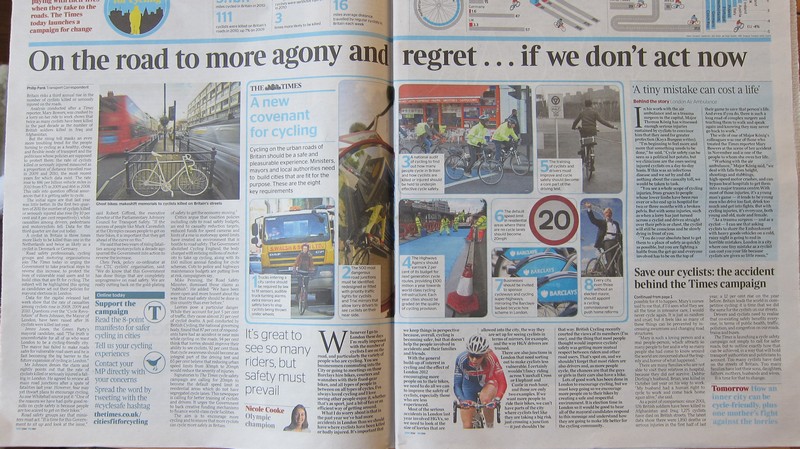
The Times #cyclesafe campaign welcome but for real impact needs to hit the Courts

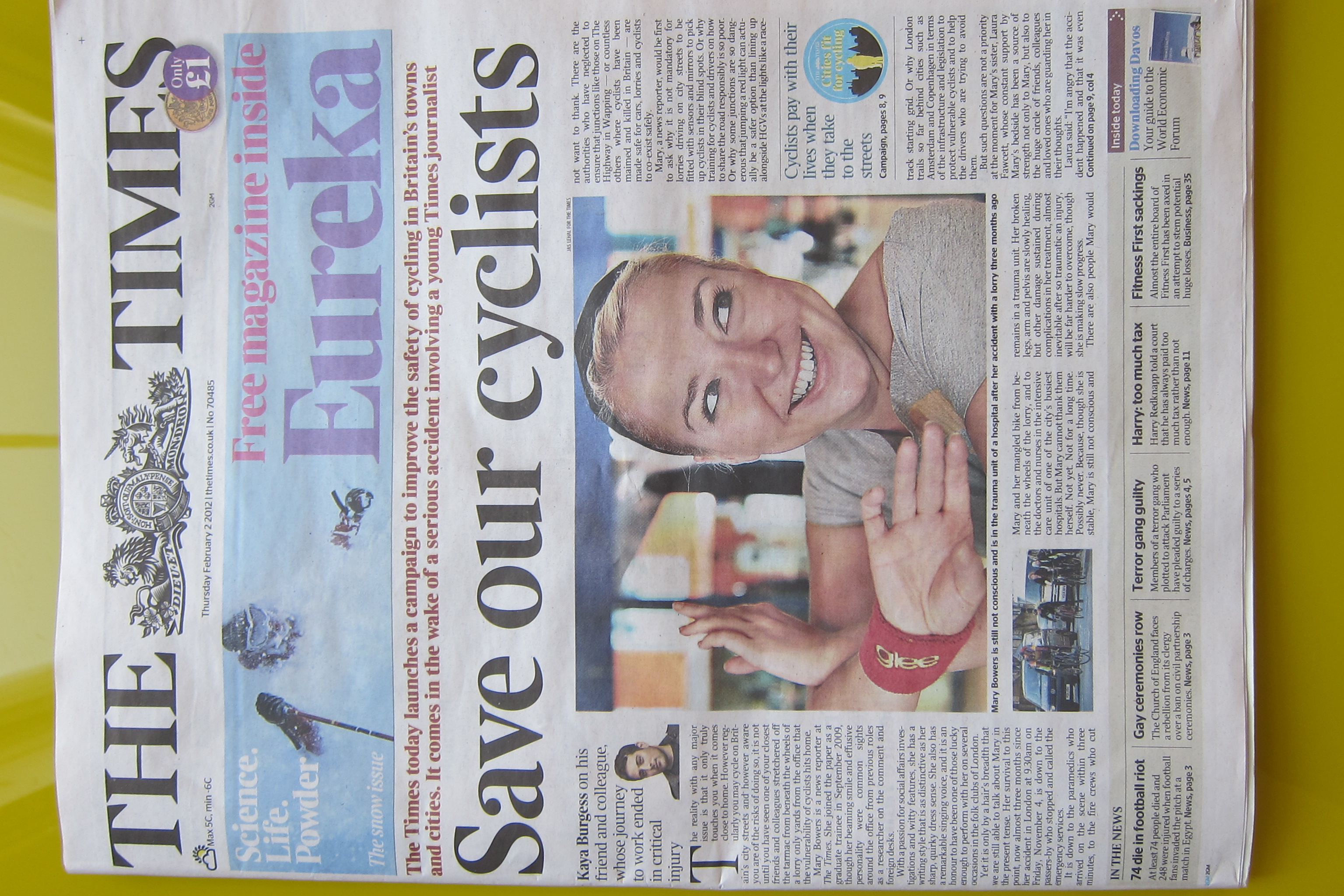
It’s great to see cycle safety on the front page of a national newspaper.  The Times is thundering away about the need for urban cycle safety following the serious injury of one of its young reporters who remains in a coma.  Kaya Burgess at the paper has been championing cycle safety for a while and it’s great to see him hit the front page.

The campaign is a great start, but I wonder if it isn’t a little naive in exhorting reviews and new bureaucrats such as cycle commissioners.  Years of hard nosed campaigning leads me to think that this sort of thing will achieve little.  In London the Mayor will announce a review of whatever he feels like that will report conveniently far after the Mayoral elections.  One or two high profile junctions will be fiddled with but the systemic problems of the Mayors traffic flow policy will continue.

The people who work in and run our major civic bureaucracies know what needs to be done to make cyclists safer at persistently dangerous junctions.  They just make the chilling choice not to do it.  They put cars and ‘traffic flow’ first.  To my mind campaigners now have to take the courts to hold our politicians and bureaucracies to account.  This is why we have driven so hard here on holding TfL to account for corporate manslaughter over the Deep Lee death in Kings Cross.

Prosecutions though mean the police upping their game to initiate prosecutions of people in councils that they work with day to day to manage safe roads.  In London the Mayor is in charge of the police and TfL, which makes things very complex indeed.

Posted in Road Safety in Kings Cross | 2 Comments