
51.534873
-0.117225

If you’ve not visited Culpeper Gardens before, then you are in for a treat. Just up the road towards Sainsbury’s at The Angel, this community garden is an absolute gem.
You can pop into the green oasis during the day anytime, but if you visit on 12 March you can join in on a talk about the wonderful world of amphibians.
If you think that’s odd for KX you’d be very wrong! KX is home to a veritable wealth of frogs and toads – you just need to know where to look!

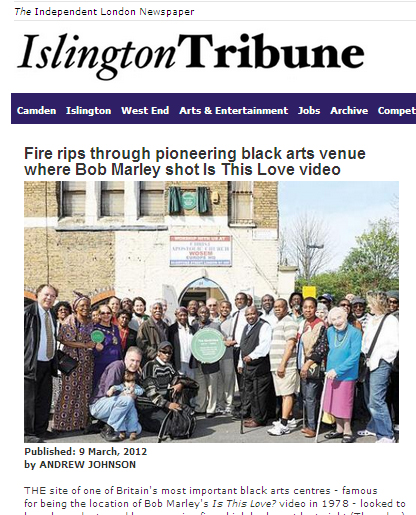 The Islington Tribune, sister paper of the Camden New Journal together covering the King’s Cross neighbourhood, is reporting a fire last night at the old Keskidee Centre on Gifford Street, once the focus of black art and culture across the UK and venue for Bob Marley’s ‘Is this love?’ video.
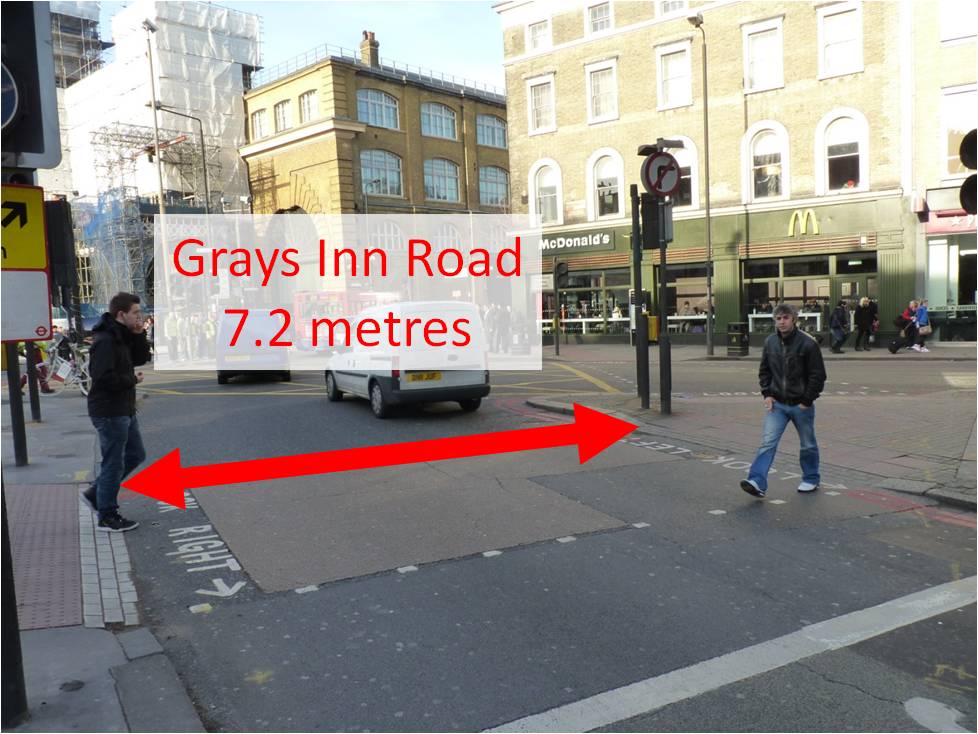 In 2006 TfL commissioned Colin Buchanan, traffic engineers to produce a cycling strategy report for Kings Cross. This report isn’t widely known locally and I am indebted to Kaya Burgess from The Times for drawing my attention to the final 2007 report as we discussed the other Buchanan report on traffic modelling in Kings Cross. There is also a draft version of the cycling strategy report from 2006. Cycle sources tell me that despite their bizarre modelling of Kings Cross without cyclists, under instructions from TfL Buchanan’s normally has a good cycle reputation.
In the draft cycle strategy report Buchanans made a sensible recommendation for the killer junction of Gray’s Inn Road, York Way and Pentonville Road:
‘An obvious solution is to convert the pedestrian crossings at the junction with Euston Road to Toucan crossings to enable access to the stations area and York Way, and for this facility to be clearly indicated well before the junction. The toucan itself should be as wide as possible to allow for heavy pedestrian traffic flows in addition to cycle traffic.’ [section ends]
5.2.3 Cycling Strategy for Kings Cross Area, Colin Buchanan & partners draft report , as online at Camden Cyclists, retrieved 7 March 2012 2010z
A Toucan crossing is one with a button and lights for a bike and pedestrians to cross while the traffic is stopped. In my opinion, had one of these been operational Deep Lee would not have met her end under a lorry as she set off from Gray’s Inn Road when the lights changed to green. Indeed she would have set off on her own before the lorry, protected by the Toucan.
It’s worth comparing Buchanan’s view in the 2006 draft report with the text in the final report, as published by TfL, who paid for it in 2007:
‘One solution may be to convert the pedestrian crossings at the junction with Euston Road to Toucan crossings to enable access to the stations area and York Way, and for this facility to be clearly indicated well before the junction. The toucan itself should be as wide as possible to allow for heavy pedestrian flows in addition to cycle traffic. However, given the restricted pedestrian refuge and footway space at this location it is likely to prove difficult to achieve.’ [section ends]
4.4.5 Kings Cross Area Cycling Strategy, Colin Buchanan, TfL November 2007
A strong recommendation has been weakened and undermined by a caveat inserted. Which organisation was responsible for these amends? Some clues come from the helpful Camden Cycling Campaign. In worthy, almost old fashioned way CCC minutes its meetings and publishes the minutes online. CCC minuted a meeting of stakeholders to discuss the draft report on 13 December 2006 at Camden Town Hall. The TfL representative, speaking for TfL CCE (Cycling Centre of Excellence) was reported by CCC as being:
‘very insistent on through traffic’
Button controlled Toucans are problematic if you want to maximise traffic flow – they take power away from road controllers and give it to cyclists and pedestrians to manage the junction on demand. It seems remarkable to me that a TFL person from a Cycling Centre of Excellence should be insistent on through traffic – the volumes of traffic at the junctions are the problem for cyclists.
The caveat about this being difficult to do at the Gray’s Inn Road/York Way junction is nonsense – TfL controls the junction and can remodel it. As they plan to do now. But the current plans omit any sort of Toucan crossing.
The final report overall is damning about cycling in Kings Cross and the killer gyratory in particular:
There are major one-way systems in the area at King’s Cross and Camden Town, which can be intimidating for cyclists.
There are extensive one-way systems to the east of the study area. These are an important factor in consideration of cycling strategies as such an extensive area of one-way working poses a barrier to cycling
The net effect of one-way working is to speed-up motor vehicles due to the wider road width available, which can
create uncomfortable environments for cycling. In addition to speeding, the stretches of multiple one-way lanes also means that vehicles can move across lanes more often, which can deter cyclists from being able to make such manoeuvres themselves where necessary….
…The short to medium-term solution for this situation is to either establish alternative cycle routes that by-pass these areas or else provide access through them utilising such features as contraflows, or some combination of both.
Kings Cross Area Cycling Strategy, Colin Buchanan, TfL November 2007
This Cycling Strategy, although little known outside TfL has been around since 2007, setting out clear and present dangers to cyclists in Kings Cross. At least one pro-cycle safety recommendation in the draft report concerning a junction at which someone was subsequently killed was weakened in the final report. Why, over five years has no comprehensive action been taken to make the Kings Cross roads safe for cyclists once and for all time?
In possession of this evidence and not taking adequate timely action TfL has unambiguously failed in its duty of care to road users who have to use its junctions and must be held to account in the Courts for corporate manslaughter or some egregious breach of common sense health and safety law.
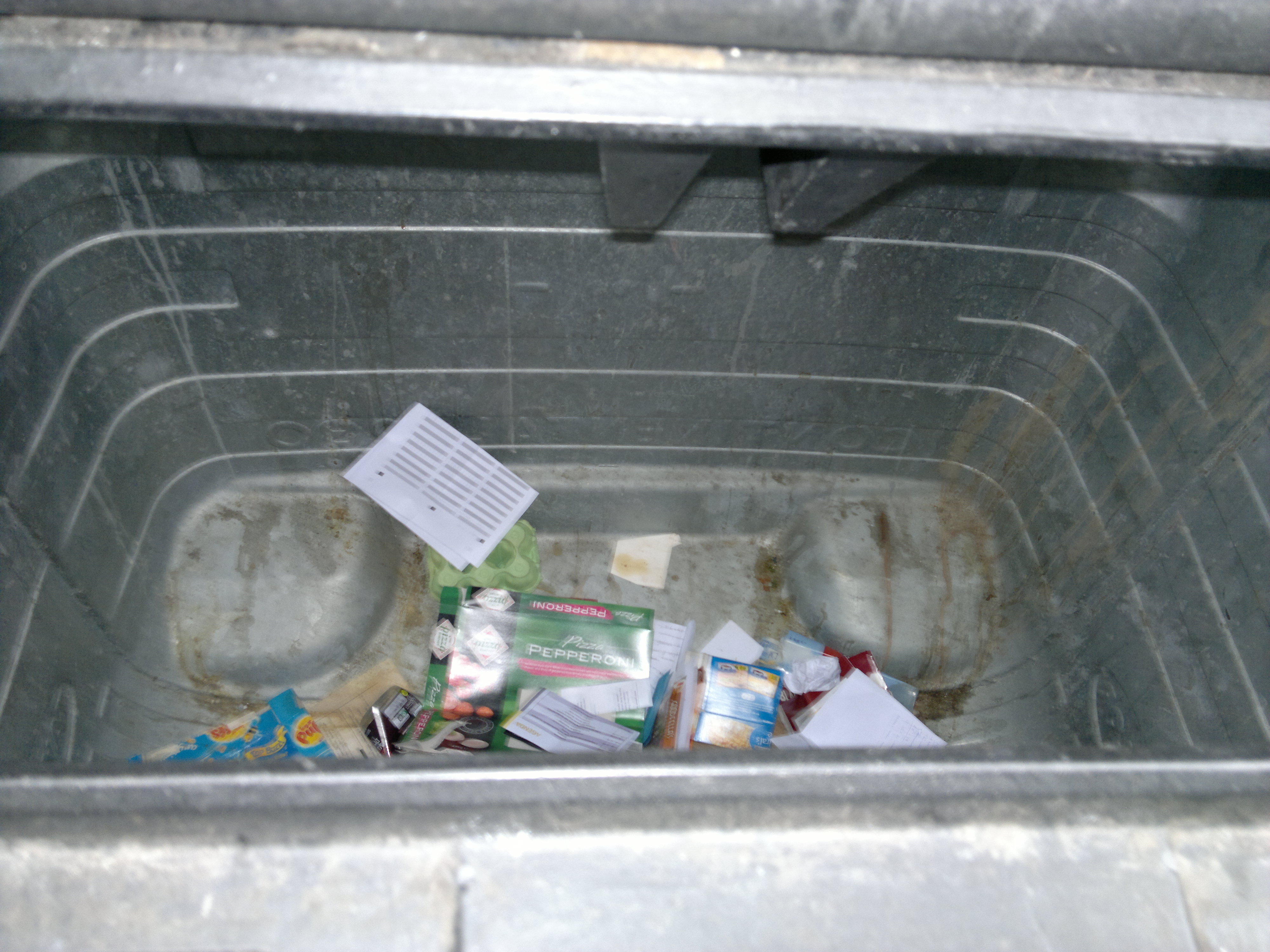
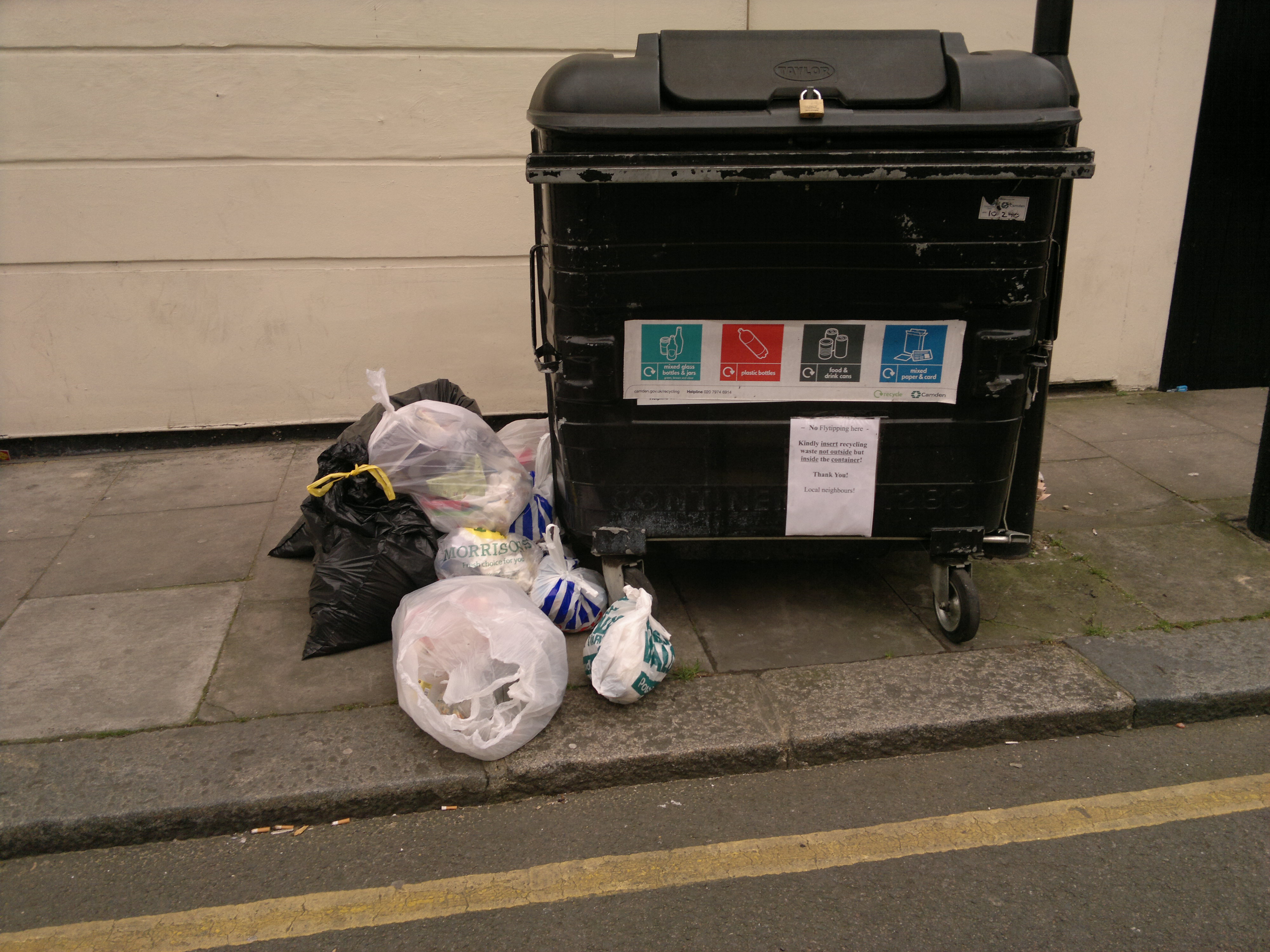
Since about a year there is a recycling-bay in Swinton Place, taking glass, plastics and papers. At first unused, it soon became quite popular as an added opportunity for locals to dispose of their recyclables during the week. Soon the container became over-loaded and full, days before emptying. And so it was for a few weeks, with bags full of waste rising to its sides.
Eventually I decided to remedy the problem, finding out that Camden empties containers that are full usually within 24 hours on notification. All people must do is to dial Camden’s main switchboard 020-7974 4444, to get through to recycling and report the container at the recycling-bay in Swinton Place as being full to brink.
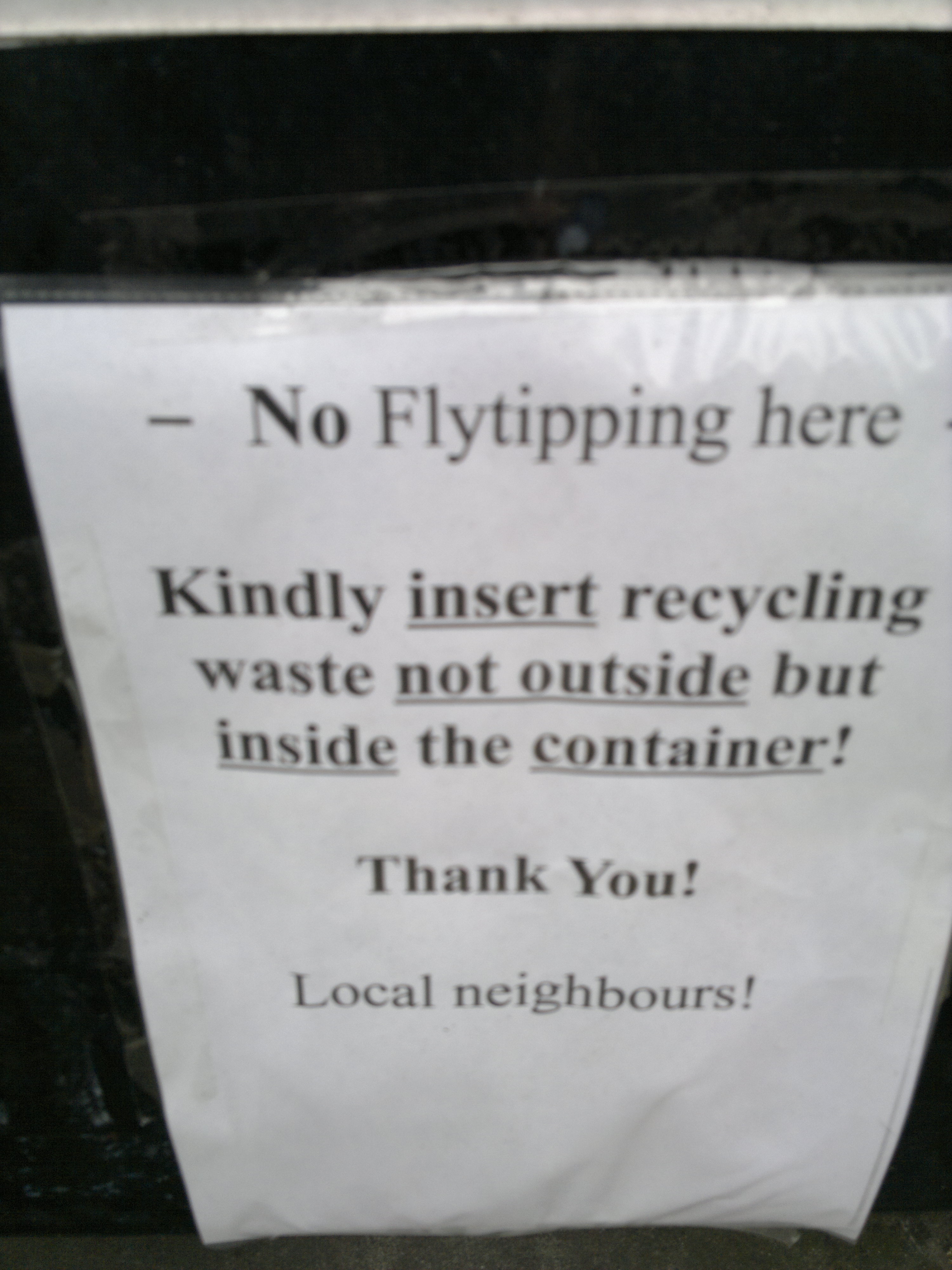
Yesterday was such an occasion and Camden emptied the container within several hours of my call. Now the container is empty (see photo). Still this morning sometimes between 9.30 and 10.45 one or several people felt the need to carry all their recyclables to the container and just dump them next to it, regardless of the fact that the container was actually completely empty. It is something that has happened before, and two weeks ago I hung up little notes asking to “please insert the waste into the container out of neighbourly respect.” Once in the morning I caught one man who also had just dumped his waste in spite of an empty container, and when I showed him that the container was in fact empty, he shrug his shoulders and walked apologetically off (leaving his waste though put). On this and on other occasions I have just taken other people’s rubbish and put it inside the container. It seems a task impossible to some.
Is it not true that if we want a nicer more communal area, we all look after it, as if it was our back-garden? This at least is the way I was brought up in post-war Germany in an era where everybody was very concerned to rethink society in a positive way for humanity. We were constantly reminded that living somewhere the democratic citizen had not just rights, such as waste collection by the council and access to clean water – but also obligations. The obligations are especially pressing when somebody else’s freedom of throwing their waste about carelessly enfrinches upon the freedom of the majority of the neighbours to enjoy the area they live in as anything but a waste dump.
I understand that also there may be cultural attitudes at work here. For example in some cultures there is no regard of what happens outside one’s door, whilst the inside of the house might be super sparkle clean. I learned that lesson, when living in an estate in Tower Hamlets and a family’s smelly rubbish (nappies included) stood in the closed public hallway for days until collection, whilst the inside of their flat could teach many about how clean one can get a home. Make no mistake in presumptions, the man I caught the other morning was in fact West-European.
I think though we have to have general regard and decency for one another, through a measure of common sense of what is mine, yours and what is public and common to all.
It includes checking if a recycling container is in fact empty. It also includes respect for the council’s rules that black bin-liners on “TFL highways (where there is daily rubbish collection),” such as on Gray’s Inn Road, Kings Cross Road, Acton Street and Swinton Street” should only be deposited after dusk.
It includes to upkeep the old rules on cleaning one’s dog mess, and littering, and beyond that, and this is often the difficult bit in inner cities, to clean up even other people’s messes.
It is enough that we suffer the effects of male late night sojourners who relieve themselves from the effects of excessive drinking in our street corners, so we as residents must not also add to this, but actively do anything we can to counter this.
It is time we plant a few flowers, take the home broom onto the street at times, and celebrate living here by making it special, through special little acts of kindness.
Kings Cross has shown in the past decades that it can grow out of its urban dumping ground status and move beyond drugs, hookers and even car chaos (even though the later is but a slow process).
Far from being marginalised and downtrodden we are also in the driving seats. It is evident from campaigns on cycling within this blog.
We must insist on continuing to build our areas as livable places. Sure let’s complain where councils or TFL fail, but we must also use our hands and souls to make this place what we all know it can be.
The 2012 London Drinker Beer & Cider Festival will be held on 7th – 9th March 2012 at the Camden Centre, Bidborough Street, London WC1H 9AU.
This is one of the few festivals where CAMRA volunteers do the catering, and they pride themselves on the variety and quality of the food on sale.

From 2005-2009 road engineers Colin Buchanan and Partners conducted traffic flow modelling and measurements in the Kings Cross area on contract to TfL. Buchanans is the daddy of traffic flow engineers and they developed a computer model to analyse the effects of junction changes. Buchanans used the model to predict whether, say making York Way a two-way road would lead to more or less traffic congestion. The Buchanan work has been heavily influential on the design of the new York Way scheme. I am indebted to Sophie Talbot for securing and posting the Buchanan report.
Buchanans May 2009 report is the most comprehensive statistical work on traffic flows Kings Cross except for one respect – TfL advised them to ignore cyclists in their modelling.
‘Following TfL advice, cyclists and motorcyclists were not included in the model as their equivalent PCU values are only a small proportion of the total traffic in the study area.’
(para 3.6.1 Final Report, Kings Cross Traffic and Pedestrian Study Colin Buchanan and Partners, May 2009)
This is despite the fact that, as Buchanans note:
‘Pedal Cyclist casualties made up 20% of the total casualties…(in the) 36 months to December 2007’
(para 4.8.2 Final Report, Kings Cross Traffic and Pedestrian Study Colin Buchanan and Partners, May 2009)
This goes some way to explain why the York Way proposals that TfL and the ODA are about to implement are so poor for cyclists and might even make the road more dangerous by increasing traffic flow with no cycle lane. On TfL’s advice, cyclists and their needs weren’t in the model that underpinned the design.
From a statistical perspective, TfL’s advice to Buchanan is odd – they seem to say that because the percentage of two-wheel traffic is low in the overall volume (a PCU is a ‘passenger car unit’) they can be ignored. Despite cyclists comprising 20% of casualties across the Kings Cross junctions. And during the time the Buchanan work was being carried out publicly available figures from DfT showed a sharp increase in cyclists on York Way in both absolute and percentage terms. Competent strategic planning for the next 20 years should accommodate that new trend.
More revealing was what TfL didn’t say – they knew that the cyclist count on York Way was going up, they had a report that said that ‘casualties were inevitable’ but TfL didn’t say to the experts they hired:
‘Cycle safety is really important to us, we need a model that helps people on bikes’
or
‘Please model a scheme that complies with our cycle design standards‘
Sophie’s work suggests that the PERS Walkability study, available for a year before the Buchanan report was finalised wasn’t shared with Buchanan.
The above is further evidence of TfL’s systemic failure in a duty of care to people, particularly cyclists who use this junction under TfL’s control. And reinforces my desire to see TfL held to account in the courts for corporate manslaughter.
Swinton Place, which is two directional, is mostly used by rat racing drivers to switch between Swinton and Acton Street. TFL argues that it is an essential diversion route in case either street has works, an event however that may occur only very rarely. Less than once every two years perhaps under my observation and mostly only during road-resurfacing
It has been put to TFL to make the street uni-directional or perhaps put a barrier in the middle. TFL pushed the ball to Camden and Camden in talks with TFL established that it was TFL’s responsibility and that they wouldn’t want to do it so their buses and traffic could get diverted through this little street on those very rare occasions.
Our suggestion to put a barrier in place or make the street traffic reduced or even a play street would stop the rat racing as well as give local residents a tiny traffic reduced island in the midst of Kings Cross.
The barrier could be of such a type that it could be removed in cases of rare need (as claimed by TFL) for example a gate like at a level crossing or removable posts as in areas where occasional access is needed by emergency vehicles.
I have some back-dated correspondence extracts on this. Given that TFL is beginning to listen to us Kings Cross residents on some issues, and that they announced a review of the gyratory system, I want to make these correspondences accessible to all now, perhaps after all Swinton Place is a little street TFL could finally allow to become traffic reduced.
Summary:
In the ideal scenario Swinton Place would become a gated play street (allowing for car parking entering from one end), with gates removable in very rare cases passage is needed.
Full access is only needed in very rare instances, not justifying all year two directional opening of the street.
—————-
Copies of Correspondences:
DO NOT DELETE………………………..
{ticketno:[903450]}
DO NOT DELETE………………………..
Dear Owen, we last spoke in 2007 (see below).
Our Ref: 1006529211/AR
Date: 09.06.2010
Dear Mr Zylbersztajn
…..With regards to Swinton Place, any consideration of one-way working or closing one end of the road should be directed to Camden Council who are the Highway and Traffic Authority for the majority of this road….
Annemarie Roche
12 Aug 2010
Dear Mr Zylbersztajn,
Acton Street / Swinton Street, WC1X – Ref 6278010
Further to your enquiry relating to the above please accept my apologies for not responding to your initial enquiry. I had made some enquiries of my colleagues at Transport for London (TfL), however not providing you with a direct response was an oversight on my part for which I apologise.
As you are aware Acton Street and Swinton Street form part of the Transport for London Road Network (TLRN) and TfL are the traffic and highway authority for these roads. I understand that you have received a response from TfL regarding the issue of traffic speed and noise levels on Acton Street and Swinton Street.
In relation to Swinton Place, Camden Council is the traffic and highway authority for the majority of this road, as stated in TfL’s response. However, TfL is the traffic authority for parts of the road at the junctions with Swinton Street and Acton Street, referred to as ‘red route returns’. As a result of the relationship to the TLRN TfL would need to be supportive of any measures proposed for Swinton Place.
I have had initial discussions with colleagues at TfL and they have indicated that they would not be supportive of either the closure of one end of Swinton Place or introducing one-way working in either direction. They have come to this view as a result of safety concerns, concerns relating to the impact on and resilience of the traffic and bus network and introducing long diversion routes as a result of one-way working in Swinton Place.
In addition to the above, the funding that the Council receives to implement such measures across the borough has significantly reduced from this financial year onwards and there are considerable challenges across the borough which places a significant level of demand on this funding. As a result of this reduction of funding it is critical that delivery and funding are directed to the areas of greatest need and that programmes of works are evidence-based and robust.
The Council will, in early 2011, be consulting upon its second Local Implementation Plan (LIP), which is the statutory transport strategy that must take a considerable steer from the Mayor’s Transport Strategy, but also sets out how we intend to achieve the objectives with the funding available. A significant level of demand for projects to improve safety and mitigate the impacts of central and inner London traffic levels is expected, and this will add to the consideration of all the outstanding requests that the borough has been unable to take forward. The eventual projected prioritisation and the programme for the next few years will then be agreed by Members following borough-wide engagement.
Your suggestions for Swinton Place will be considered as part of the development of the second LIP. However, given the position of TfL and the pressure on resources I can provide no guarantees that your suggestions will be taken forward.
Yours sincerely
Louise Bond
Camden Acting Head of Public Realm & Transport Policy
 | William Pitt-Jones on Rufford Street local hist… |
 | Shirley Nicholson on Kings Cross voices back on the… |
 | Cally Labour Council… on End of the road? |
 | Daniel Z. Zylberszta… on End of the road? |
 | Tony Rees on End of the road? |
| Daniel Z. Zylberszta… on Yes! It’s all gone 20 mi… |
 | Edward on Yes! It’s all gone 20 mi… |
| TFL Consultation… on New Consultation Launched for… |
 Pollution levels on Euston Road King’s Cross weather (BBC)
 Kings Cross Environment