‘Please be quiet we are sleeping in this death trap’ – is this Cally Road tenants speaking out in pavement graffiti?

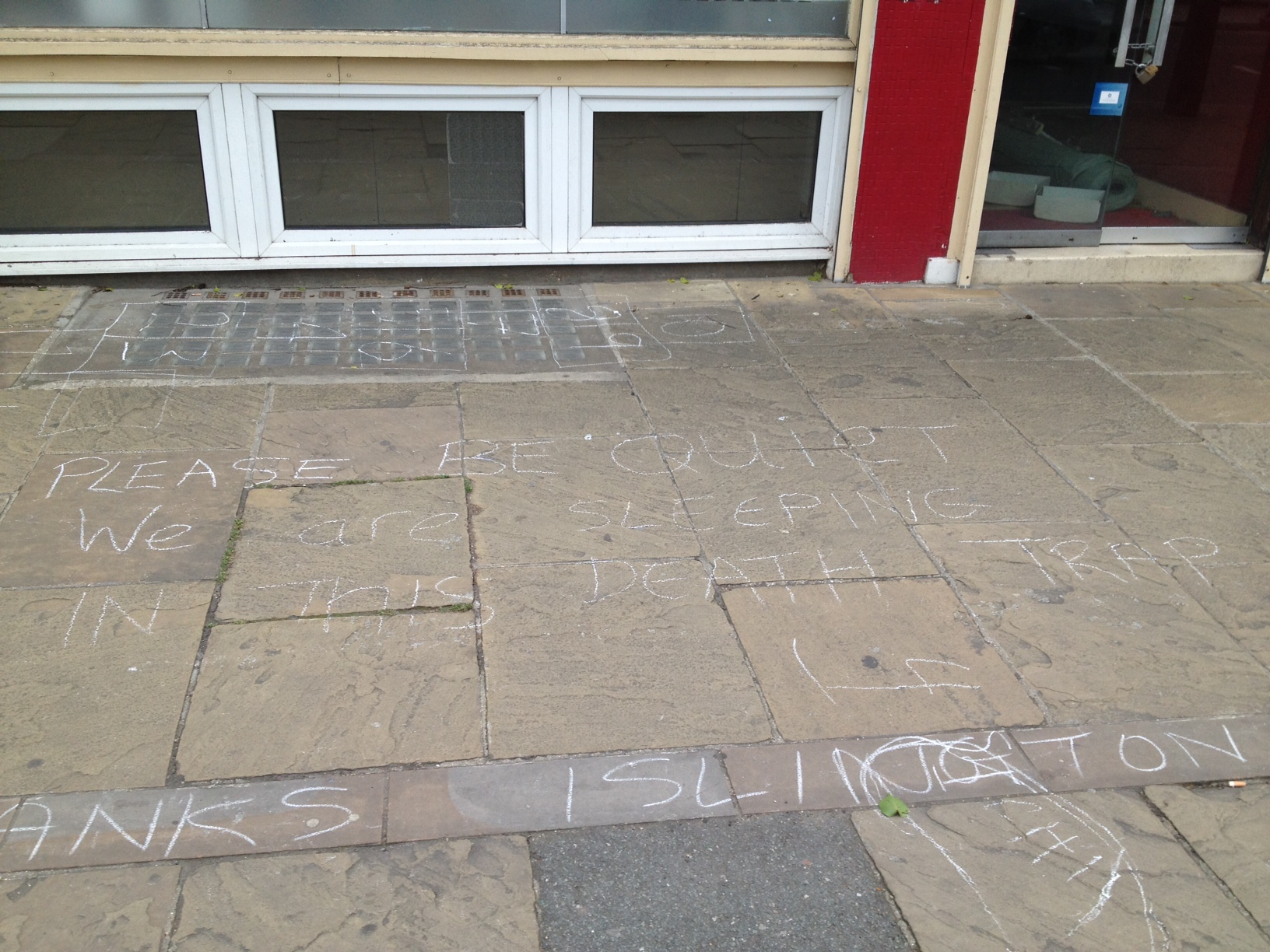
Some topical pavement graffiti spotted by locals Nina and Aron on the Cally Road outside number 334-336 (photo is Nina’s).

‘Please be quiet we are sleeping in this death trap. Thanks Islington’

The chalking around the pavement light probably refers to  underground ‘flats’ of the type revealed in the recent BBC documentary where cellars are converted into four or five rooms.  Is this a cry for help by a resident?

The writer also has a dig at Islington Council for allowing this to go on.  Over on the Cally Councillors blog Cllr Convery has recently said

‘Over the last 10 years or so, it is clear that the Council’s planners simply did not have the determination to challenge and enforce against these sorts of planning breaches. Nor did they get the signal from the Town Hall or elected local politicians to do so. However, the current Caledonian Councillors and the Town Hall leadership does have the political will to bring enforcement action.’

Posted in Anti Social Behaviour, Crime etc, Planning, Licensing and Regulation | 5 Comments

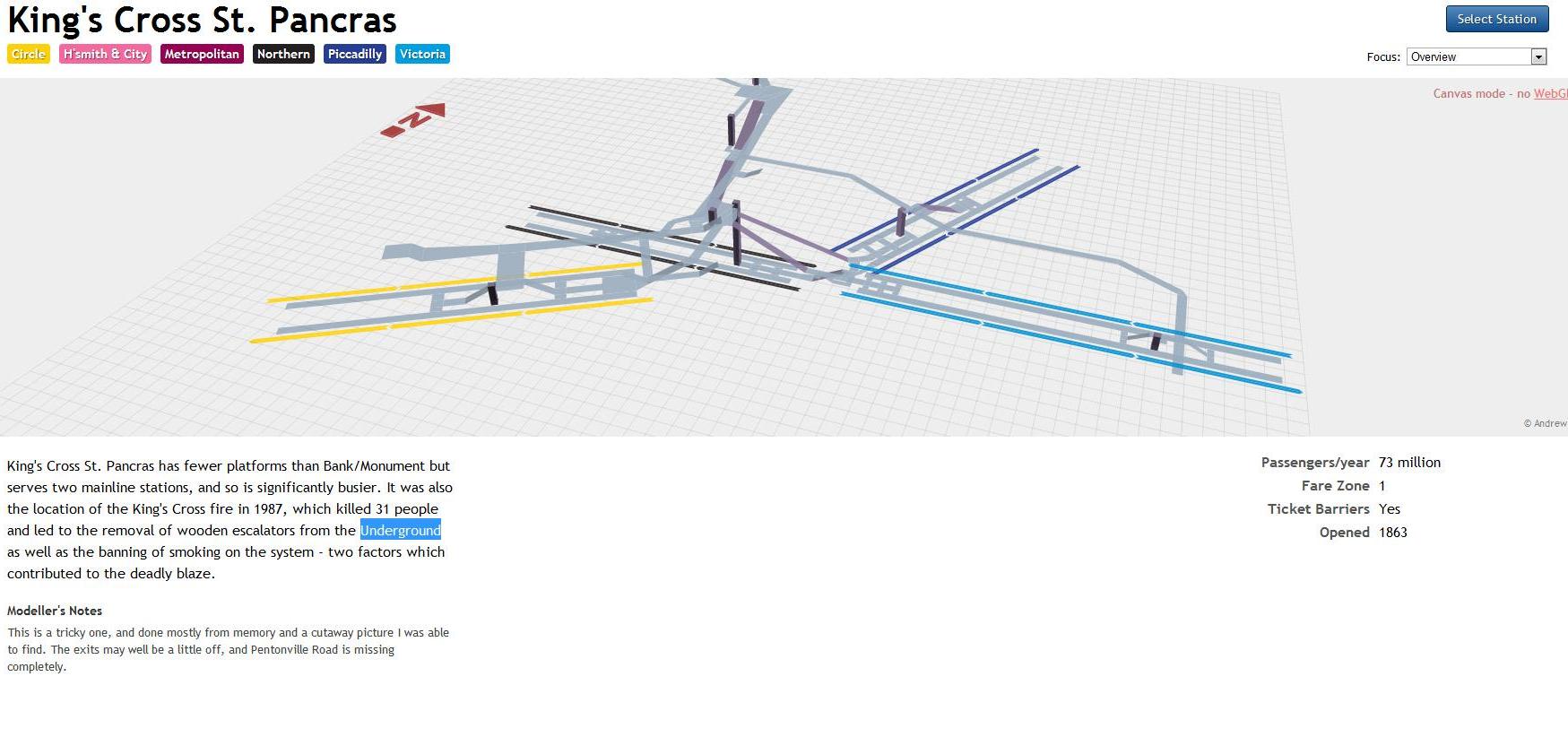
3D map of Kings Cross tube station


Thanks to Anna for alerting me to these rather wonderful 3D maps of Kings’ Cross underground.

Posted in Transport | 1 Comment

Exhibition at Work 10a Acton Street on Haus Rucker and Co

Exhibition at ork Acton Street Haus Rucker

The gallery states:

WORK is pleased to present a retrospective of key projects by avant-garde Viennese architectural group

Haus-Rucker-Co.

Haus-Rucker-Co.’s designs for inflatable structures, prosthetic devices and interventions into public spaces were also blueprints for social change and an experiential theory of architecture. Situating itself in the transitional ground between architecture, design and action art, the group was unique in its distinctive emphasis on the perceptual realm.

Their pneumatic projects aimed to counteract apathy and passive acceptance of one’s environment by distorting the experience of public and private spaces, evoking a “feeling of foreignness”. Immersive environments, bubble and capsule forms, and mind-expanding structures for private contemplation or forging personal connections all delineate not only specific physical zones but also psychological spaces. Haus- Rucker-Co. also took a playful approach to architectural materials and strategies. Plastics—mutable, flexible, inexpensive, and with seemingly infinite potential—provided not only the material for many of their projects but also served as a model for the era’s futurist vision of a democratic and mobile lifestyle.

Inner World / Innen Welt presents a comprehensive selection of archival drawings and collages, photographs, models and ephemera spanning Haus-Rucker-Co.’s 25-year collaboration. Some of the projects on display were realised in public spaces; others remain virtual—and often fantastic—solutions for social, political or environmental concerns. Exhibited projects include Oase Nr. 7, a bubble-like personal oasis which protruded from the façade of the Museum Fridericianums during the 1972 Documenta; Gelbes Herz, a psychedelically-patterned “communications space-capsule for two people”; Rahmenbau, a giant framing mechanism contrasting urban sprawl with the natural landscape; and Cover, a temporary white inflatable casing erected over Mies van der Rohe’s 1921 Lange House in a gesture of architectural dialogue.

Inner World / Innen Welt marks the 20-year anniversary of Haus-Rucker-Co.’s dissolution with a celebration of the broad scope and conceptual density of this extraordinary group’s output. Haus-Rucker-Co. was founded in 1967 by Laurids Ortner, Günther Zamp Kelp and Klaus Pinter, later joined by Manfred Ortner. The group has exhibited internationally, including participation in Documenta 5 and 6, and was the subject of a major exhibition at Kunsthalle Wien in 1992, the year of the collective’s dissolution. Already working together as Ortner & Ortner on major building commissions from the mid-1980s, Manfred and Laurids Ortner went on to develop an extensive portfolio of built projects, propelling the preoccupations of Haus-Rucker-Co. into a new realm.

To coincide with the exhibition, WORK is also pleased to announce a limited edition photographic series by the artists, and a special edition of PAPERWORK that locates Haus-Rucker-Co.’s practice within broader aesthetic, historical and socio- political contexts.

Posted in Arts and Entertainment | Tagged , , , | Leave a comment

Now close Pentonville Prison for good

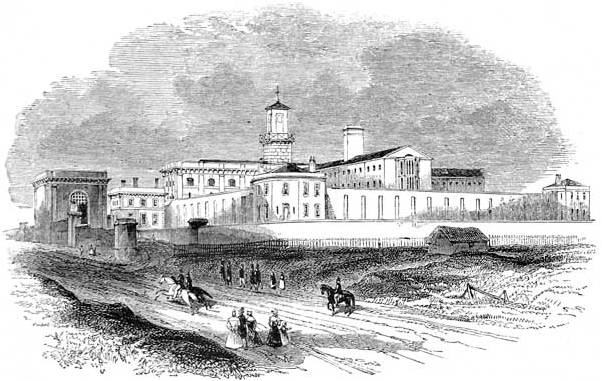
The news that the somewhat tragic elderly murderer John Massey managed to escape from Pentonville Prison by climbing the wall with an improvised rope beggars belief.  This underlines that the Victorian prison is no longer fit for modern use.  In 2010 local councillors called for the prison to be closed and the site used for a residential scheme.  Surely now is the time to shut this out of date, troubled institution and replace it with a modern facility outside London.

Posted in Anti Social Behaviour, Crime etc | 2 Comments

Complex story of Pentonville escapee John Massey

The media is full of ‘escaped murderer John Massey’ this morning.  The media and police will of course seek to sensationalise a prison escapee. A Police Spokesman said:

“Police are appealing for help in tracing a convicted murderer who has escaped from HMP Pentonville.

John Massey 64 ys made off from the Islington prison at approx. 18.30hrs today (Wednesday 27 June).

He is considered potentially dangerous and should not be approached by the public if he is seen.

He was sentenced to life imprisonment for the murder of a man at a Hackney pub in September 1975.

Anyone with information of Massey’s whereabouts is asked to call Islington Police 0207 421 0296; if you wish to remain anonymous please call Crimestopppers on 0800 555 111.

With an immediate sighting of Massey, call 999.’

A Prison Service spokesperson said:

“At approximately 6.30pm on Wed 27 June a prisoner was found to be missing from HMP Pentonville.

“Police were immediately informed and the matter will be the subject of a thorough investigation.”

I keep a close eye on Pentonville media, even though the prison won’t talk to this local website (MOJ press office is stuck in the dark ages).  Mr Massey’s name rang a bell and I recalled this on his unusual story from the Guardian which I quote fully in the spirit of ‘open journalism’.  The Camden New Journal has done some good work on his story too including this very good interview in prison (other links in comments below).

Clearly I don’t condone Massey’s actions in the 1970s when he killed someone called Higgins at the Cricketers pub in Hackney.  But after 35 years in prison this treatment is startling. I’m with Lord Ramsbotham (see end):

In 1976, John Massey, now 63, was sentenced to life for murdering a club bouncer after a drunken row. He was released in June 2007.

Before he was freed, Massey had been preparing for release for 18 months in an open prison in Derbyshire. Granted home leave, he was let out for five days every month to be at home with his family in London and visit his father in hospital. “I got myself a terrific job – shop fitting,” he recalls. “For the first time in my life I was fully legal and it felt wonderful. All that changed when I got parole.”

His sister had offered a home with her in north London, but the probation service insisted he live in a bail hostel in Streatham, south London, some distance from his family in Camden. He describes the hostel as dirty and with more rules than the open prison he had just left.

Massey complied with all the rules for several months until his father’s imminent death forced him to choose between his family and his liberty. Although two doctors were prepared to verify that his father’s death was near, his pleas for an extension of his curfew were rejected. He stayed with his dad, Jack, who died four days later. Without waiting for the funeral, Massey turned himself in to the police and was immediately recalled to prison.

Two and a half years after that breach, Massey thought he was on the verge of freedom again. He had been decategorised and sent to another open jail, Ford, in West Sussex, seen as a stepping stone back to society. Then in May 2010, his awful history almost repeated itself. He received news that his sister, Carol, was gravely ill. Massey asked if he could be granted release on temporary licence but was told he could not be trusted. He then pleaded for an escorted visit to the hospital but was again rebuffed.

“We haven’t got the staff,” he recalls being told. “In desperation, I walked out and went straight to the hospital – ironically, the same one where my dad had died.” Massey did not leave Carol’s bedside until she died two weeks later.

This time he didn’t return to jail. He went to live with his 85-year-old mother in Camden and waited for the inevitable. Ten months later, it came: “I just waited for the knock on the door. When it came I was out back building a summer house extension. I wanted to do as much as possible for my mother before the police came.

The former chief inspector of prisons, Lord Ramsbotham, describes this as a very sad story, where common sense should have prevailed. “Of course, technically, Massey is in the wrong. But that’s no excuse for clogging up an expensive system with people from whom the public do not seem to need to be protected,” he says.”

[Post updated slightly at around 1100 to reflect official police and Ministry of Justice lines and CNJ links]

Posted in Anti Social Behaviour, Crime etc | 8 Comments

Pentonville Road from Rodney Street to Cynthia Street: redevelopment plans

Pentonville Road Poster Flyer

Posted in Architecture, Noticeboard, Planning, Licensing and Regulation | 1 Comment

The Cally – planning enforcement is possible, it just doesn’t happen very often

Many people were appalled by the flagrant disregard of local planning rules displayed by a local landlord and property developer on last night’s BBC documentary about the Cally.  It was striking that he was cynically exploiting the lag/drag in planning enforcement that the council displays periodically.

UPDATE – a good post from Cllr Convery over on his blog

Cllr Paul Convery comments “Andrew Panayi is well known on the Cally and is a likeable, larger than life character. But some of his business practices seem distinctly suspect – as he himself admits in the TV programme. But he is wrong to think he can get away with this. The Council is currently taking enforcement action on a number of properties he has constructed recently. Recently we opposed a particularly large development to construct another floor of bedsits above the Co-op and the planning permission was refused.

But it is possible to get some resident-initiated enforcement.  Way back in 2006, just after I had started this website I got a call from Gloria Johnson who, from her eerie in Perth House had spotted huge piles of rubbish on the fire escape at Residence Primrose, i believe the building over the Co-op that was fleetingly referred to in the film.  And the fire escape that was crudely constructed from scaffold poles and wooden planks – not the best material for a  fire escape.    I took photos and  reported this to the council, the fire escape was cleared.  A few years later in 2009 a similar problem occurred.  I raised it this time with Cllr Paul Convery who organised a snap inspection as he reported in the comments on the blog post.  Council officers reported:

An Environmental Health Officer and Building Control Officer have visited the premises and can confirm that the premises does not require a licence as a house in mutiple occupation.

The Buidling Control Officer can confirm that there are no immediate structural safety concerns and is reviewing the case files to audit compliance with the current Building Regulations.

Following the survey some safety issues were identified with regards to the internal and external fire escapes and a concern with the fire alarm. The Environmental Health Officer will be working with the London Fire Brigade and will ensure that these concerns are dealt with.

The landlord is currently fully co-operating with the Council, but should progress and co-operation not be forthcoming, we will then require any works by a formal notice.

The fire escape was subsequently replaced with a proper steel structure.  This is of course an isolated example where I used a local environmental body (the then Task Group) and then basic publication to work with the council to drive some simple enforcement.    I strongly believe that observant, active local people have to work with the Council to get stuff done.  But you can only get so far that way.

Over on the Cally Councillors blog you can see Cllr Convery stopping yet more flats being built above the Co-op and an epic multi-year campaign to take planning enforcement to its logical conclusion and demolish illegal buildings on Pembroke Street.  Despite some individual heroics though, something has been up with the system as a whole.

Posted in Anti Social Behaviour, Crime etc, Planning, Licensing and Regulation | 2 Comments

Is the Cally ‘a sh*thole’?

Last nights’ BBC documentary ‘The Secret History of Our Streets’ (iPlayer) was a remarkable history piece about the Cally Road and its environs.  For a BBC documentary, the film pulled few punches (except organised crime, which was strangely absent).

Over the years, I spent a lot of time in Cally cafes, shops and launderettes and at endless campaigning community meetings.  Including some rare enforcement action against a local landlord who may have featured (more later).  In the 1990s I lived on Wharfdale Road for a year or so in the thick of the sex and drugs trade.  I lived on the Cally for a year or two over ten years ago in a tiny flat in the one way system, then moved up market to Rufford Street, at the back of the Bemerton for eight years.

The Cally wasn’t an easy place, living in the area for me was a sort of sado-masochistic residential experience.  The waves of crime and in your face poverty offset by strength, depth of  character and sheer determination from local people, fighting from one day to the next.  Perhaps typified in caricature at one extreme by the late Gloria Johnson.  But little sentimentalism for the old days, little illusion that life was wildly better then.

Unexpectedly the film makers and participants captured this – the general sense that you can move out of the Cally but never really leave it.  A bit like banging your head against the proverbial wall – it only hurts when you stop.

What do you think?  Was the film balanced? Do you recognise that Cally Road, the ‘sh*thole’ as described on camera?  No film can ever be all inclusive, but was it fair to show that angle?  Let us know what you think in the comments (remember we moderate so behave).  Apologies in advance to anyone offended by the language above.  If you want to see some more Kings Cross local history click here.

Posted in Kings Cross local history | 21 Comments