
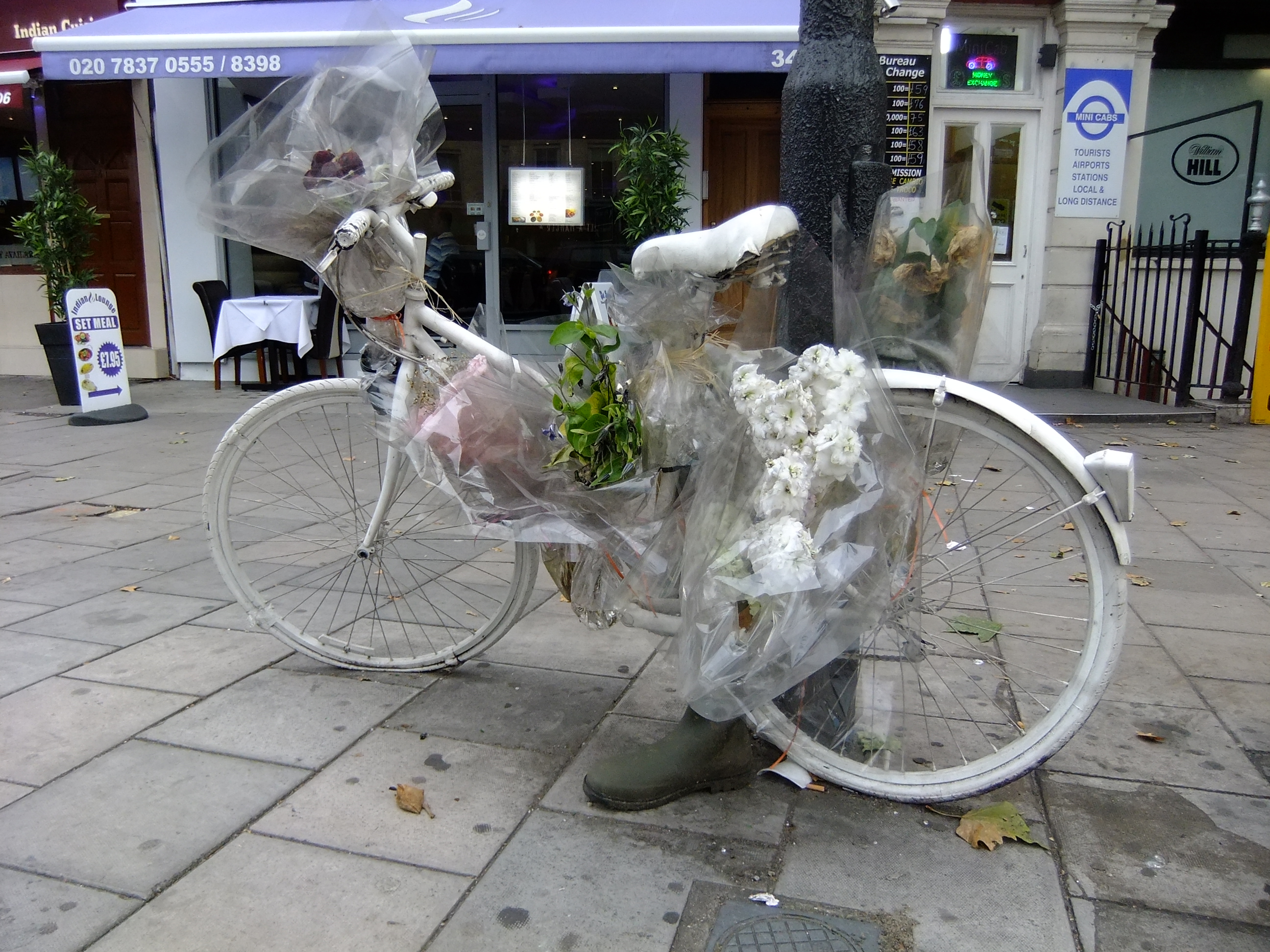
pollution (Photo credit: nada abdalla)
Open letter to meeting on Kings Cross Roads between TfL and Camden (17th Oct. 2012)
Note: This letter is the opinion of a resident of Kings Cross, non affiliated to any party or group. It represents his view and position alone, though many residents of Kings Cross may echo the opinion.
Dear interested parties.
I have waited for this meeting for 15 years. Sadly I am not able to attend the meeting on the 17th of October 2012, so I decided to write to you in an open letter:
I have lived in Kings Cross with my wife since 1997. First in Calthorpe Street and then in Acton Street. The way Kings Cross has been treated traffic wise is beyond anyone’s understanding. I do not wish to go through all the letters and emails sent to Tfl, my electoral representatives (on all levels and of many parties) and my housing association Circle Anglia. Any look on the different maps of Kings Cross (London noise map, London air pollution maps, London accident maps) reveals that people who work or live here sacrifice(d) their health and years of lives for this “choice.” For us it wasn’t exactly a choice at the onset. We were given a housing association flat in Acton Street and we were unable to find suitable swaps.
Now since four years we have a daughter who is being forced to suffer the consequences of general inaction regarding the traffic situation at Kings Cross which affects all residents and all people who work here.
Noise:
Until this day it was impossible for my daughter to sleep in her bedroom because facing Acton Street it was simply too noisy. If you look on London’s noise map you will be able to verify that at the section that we live on the noise can go to over 70db to 80 db, recognized by WHO as detrimental to human health (see below). As a result she was forced to sleep in our bedroom (North facing) until now, but it is a relative quiet because on the other side is Swinton Street another very busy road. Only this winter are we to get a double window system on grounds of heat loss. The housing act fails to recognize noise penetration as a factor in old buildings until this day, and so even with the double window system we won’t be able to get modern specialist noise reducing windows (we know because we went all the way to the housing ombudsman with this point, if you want to win with this one you must make a human rights case through the courts – lack of peaceful undisturbed enjoyment of the home).
But this is beyond the point I wish to make. What causes the noise are especially lorries and taxis accelerating on the slight uphill slope here in Acton Street and elsewhere. Royal Mail central post office (Mount Pleasant) lies a few 100 yards South and day and night their lorries travel through this and other Kings Cross roads. Especially at night, like at 4 a.m., the vibrations coming from these lorries and their freight are extreme. Of course there are also other lorries and vans with their essential deliveries to sleeping London.
We and others have campaigned for the speed limit to be lowered to 20 miles so that cars and trucks have no need to accelerate that much. Also any lorry delivery based businesses including Royal Mail and Smithfield Market meat and poultry deliveries must be encouraged to have the very highest specifications possible in reductions of noise and pollutants, if they wish to be granted continued permission to retain their inner city locations. Nobody tells them to go, this is not what we want. But if they wish to stay put in the inner city of London, and Kings Cross is part of that, then they need very special and modified vehicles to enter. Inner city locations can not be treated like the middle of an industrial zone or on the countryside. Until the vehicles reach their destination they go through areas where millions of people live and work. They hear and breath the sum of that traffic.
WHO on noise:
“Cardiovascular effects have also been demonstrated after long-term exposure to air- and road-traffic with LAeq,24h values of 65–70 dB(A). Although the associations are weak, the effect is somewhat stronger for ischaemic heart disease than for hypertension. Still, these small risk increments are important because a large number of people are exposed.
The correlation between noise exposure and general annoyance is much higher at group level than at individual level. Noise above 80 dB(A) may also reduce helping behaviour and increase aggressive behaviour. There is particular concern that high-level continuous noise exposures may increase the susceptibility of schoolchildren to feelings of helplessness.”
Source WHO
Beside the 20 mile speed reduction and the very best of noise reducing engines, I have another suggestion, can the London Mayor / London Development Trust help to part-fund better windows on those streets the London noise map shows noise exposure of 60 db and over, such as Acton Street, Swinton Street, Grays Inn Road, Caledonian Road, Pentonville Road, Euston Road and others?
Air-Pollution:
Nobody can doubt today that London has one of the worst air-pollution levels in Europe. It has been widely reported including through the London Mayor‘s own statistics that Diesel engines cause the majority of London’s pollution levels, especially in fine dust particles that are extremely dangerous. Kings Cross, Euston Road and Marylobone Road are without doubt some of the worst affected roads in Europe. But where is the action? Any other enlightened society concerned about human health would have regulated in such a way that the air improves in these areas, especially where it is so very bad and so clearly caused by vehicles (as studies by Kings College suggests due to accumulation of carbons which only come from cars).
All vehicles with diesel engines (52% of all new vehicles on the road) who wish to enter the congestion zone ought to be retro-fitted with filters that remove PM10 and PM 2.5 pollutants alongside carbons. This includes especially all the 23.000 regular black cabs (1/3 of the pollution comes from them according to the London Mayor Statistics), and TfL buses. Where is the regulation demanding this? Kings Cross alongside the rest of London would benefit from a tightening of the green zone regulations on this matter (green zone so far only considered age of van as a factor, and not a London appropriate limit of measured exhaust emission or noise level). 1000 of the 8.500 London buses said the mayor are to be retrofitted with modern filters, but I would argue it should be all buses that cross the inner city areas including Kings Cross and the most polluted areas of London.
It can not be that TfL and the UK Ministry of Transport wish to continue to be so inactive at situation that causes 4.267 deaths (2008) alone per year (in London) linked to air pollutants at an estimated London-wide cost of two billion Pounds and a UK-wide health and social impact that costs the nation 8-20 billion Pounds per year, with up to 50.000 deaths UK-wide connected to air pollution each year. The 10 million spent on saline spray and retrofit filters in London are laughable compared to the full annual costs and losses the government and London makes (because of the pollution). At that the saline only reduces the pollutants by up to 15% and when it dries you have small particles plus dried salt in the air. Thanks, but no thanks! One-off regulation at a fraction of the annual impact costs will make permanent savings in this regard and rescue millions of peoples health – full stop, end of story! Beside this is also a legal issue going into EU directives that have not been followed. Whatever you think of the European laws, at the end it is us the residents of Kings Cross, of London, of the UK, that local and national governments ought to care for.
Some of the roads with over 10.000 vehicles are less than 150 meters away from nearby schools at Kings Cross, including Argyle Primary, Christopher Hatton Primary, Elizabeth Garrett Anderson Secondary, Gower Street Primary, The 1A Nursery Centre, Kingsway and Westminster College to name but a few. Research suggests that children who are in such schools have a 15-25% higher chance to suffer asthma. Other studies talk about infringed lung capacity development and traces of pollutants in the blood stream against which the young bodies fight.
No representative of whatever party can say that saving lives and preventing illness is not the foremost important issue they ought to stand for. This counts doubly if we are talking about children and other vulnerable groups. There may be temporary financial discomfort to some businesses for example through the implications of having to retrofit extra filters to their exhaust, but the long term benefits to all outweigh these, and isn’t it the utilitarian liberal principle that so often guides British politics? In fact, if you take cab-drivers and bus-drivers, they will be the first benefactors because it is them who stand day in and out in traffic behind the exhausts of others. There are many and consistent health related studies on the health-costs to bus drivers caused by exhaust pollution. So do it for those whose living driving is too.
Fuel:
I think that all petrol stations in London ought to have ethanol based fuel alternatives or similar alternatives as an option at every petrol station. Cities like Barcelona have shown that it can make a difference, even though environmentalists rightly state that ethanol and bio-fuel have other problems mainly through monoculture that competes with crops for human consumption. But in terms of air pollution they are useful. Since London is so very much polluted in this regard it ought to be part of the consideration.
Speed:
All the Kings Cross gyratory roads suffer from occasional speed accelerations above 40 to 50 miles an hour. Actually I admit – TfL was always quick to point this out – I have never measured it, so you have to take my word on it, but you just know, everybody in Kings Cross knows. It is simply the width of the roads that elude drivers to take advantage of it. When you consider that my daughter is four, alongside so many other children and that these offences do occur during school runs as well, you know that it is only a question of time until serious accidents happen. Nobody says Kings Cross should be a no go zone, but it serves a huge amount of people, and hence Kings Cross / inner city must mean lower speeds than even on normal urban roads regardless whether this is a A or B road.
Cycling:
Thanks to Camden and Islington political leadership, especially in the last years, a lot of the smaller roads around Kings Cross have been opened up to cycling. Not all roads such as Harrison St, Sidmouth Street, Mecklenburgh Square and Cromer Street are yet 20 miles zones, but many are, and many have new special bi-directional exemptions for cyclists. Some streets like Cruikshank Street may be added soon. Thanks to TfL too we have seen a huge increase on Barclays Bank Bicycle Hire Scheme bikes. This reduces the reliance on other vehicles.
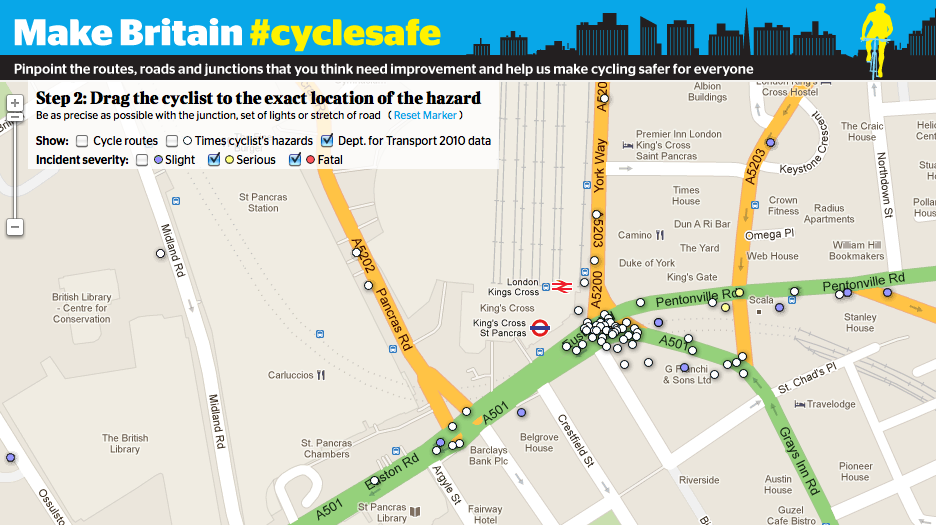
However the gyratory remains in many parts unidirectional. I myself can not go East or South without having to push the bike. I believe all gyratory roads should have save counterflow provisions for cyclists, or in fact, many suggest, for all traffic plus 20 miles speed restrictions. This also increases safety for pedestrians and cars, because cyclists no longer would ride counter flow on pavements or streets. In fact as these are busy roads they should have very robust cycle paths, by which I mean they are not infringed with by other road users, and the cyclists do not disturb the others . But there is more to the infrastructure. Coming down from Pentonville Rise and following into Swinton Street requires still a high skill from a cyclists, likewise from Caledonian Road into Kings Cross Road, and the other named areas such as Grays Inn Road into York Street which made it regularly into the media. There has been detailed analysis and many suggestions on how the infrastructure could improve here to favour people who walk or cycle (for an general overview see Kings Cross Danger Map) I would urge those with the power to act instantly.
Crossings:
There are not enough crossings, and some of the pedestrian and cycling crossings force people to wait for too long. Again keep children and vulnerable pedestrians in mind, rather than just how fast and well traffic flows through our area.
Education:
TfL has made a start with its switch off! radio and poster campaign. This ought to be continued and widened. There is also always a question why people need to go to Kings Cross using a car at all, unless they have disabilities. I still observe some local business owners communing by car without using these in the day time. Why? Like three major national train stations, half a dozen of underground lines and many bore bus lines are not enough yet? But also young people living in London ought to be encouraged to see bicycles, public transport and car sharing as the cooler option than owning and racing cars. There is a vision to sell here that can have many facets.
Summary:
- Let’s make a line under the history and move forward, we don’t need blame, we need action more than anything else. In the past people thought differently about traffic and modernity. We all move on, even I write as a former “petrol head,”having owned a VW beach buggy, desert racing car and a motorbike at different stages in my own life. But now we understand the implications of the 20th century thought, which is still very powerful, let’s redesign, re-educate, and re-regulate to our best ability and understanding.
- 20 Mile Zone around stations / gyratory throughout and controlled, or by street narrowing or winding that makes it hard to drive beyond 20 miles.
- Sharpening of regulations as soon as possible for road based traffic to further reduce noise and air pollution of vans (in case of Royal Mail maybe more cycle based deliveries)
- Inner city zone new regulations to have new PM10 and PM 2.5 air filters for all diesel engines entering it within three years, including all taxis and all Tfl buses.
- London Green Zone to follow this within 5 years .
- Consider making all of Kings Cross gyratory Euston, Marylebone and Pentonville Road part of the Congestion Zone.
- Gyratory to allow counterflow cycling or counterflow traffic in general
- Fund for noise reducing windows for council and housing association tenants in affected roads where noise goes beyond 60 dB.
- Special awareness and care where traffic is near schools, hospitals and elderly homes.
- Continue and widen education
The future:
There is no reason why London could not show the way to others. Never mind where we are today, you are all able and talented people entrusted with the task of coming up with solutions that serve millions of people. Health and well being are the priority of all, because not following it injures people by virtue of your inaction. There is no excuse for that. This is your chance to do something. We have no choice but to move forward. The way inner-cities are seen in many countries now are as humane and human hearts of cities, models to how life can be great in metropolitan areas. So when somebody will arrive with the Eurostar in three or four years let them see the future and say “we have something to learn from these Londoners.” We can do it! Will you not be too shy to act!?
Daniel Zylbersztajn
Kings Cross Resident of Acton Street
51.508129
-0.128005
 Readers of kingscrossenvironment.com can claim a 10% discount for a lovely sun bed as winter approaches… just quote (weboffer2012).







 Kings Cross Environment