Click here for more information about the London Canal Museum’s Ice project

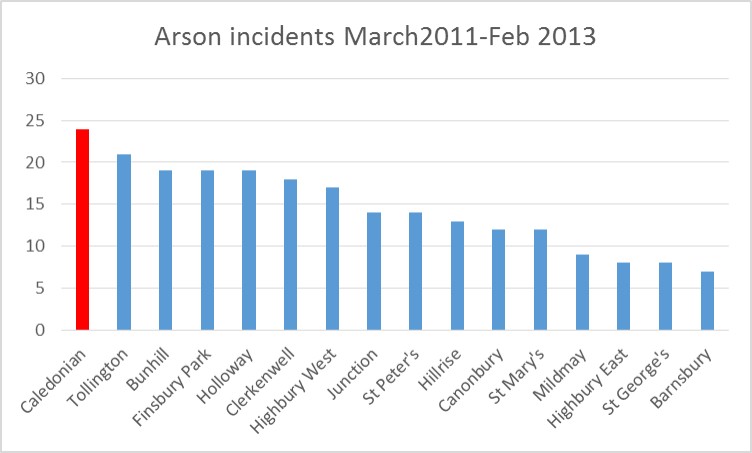 London Fire & Emergency Planning Authority data shows that arson incidents in Cally Ward have fallen by more than half in recent years. From more than two per month to less than one per month. New data from March 2011 -February 2013 shows a big fall compared to the period December 2007-November 2009, continuing the lower trend seen in 2009. In the 2007-2009 period there were 58 incidents: in 2011-2013 period there were only 24.
The total numbers in the Caledonian Ward are now becoming more typical of other wards in Islington. Cally Ward although still the worst in Islington is no longer head and shoulders so (see this chart of 2007-2009).
This dramatic fall in arson is testament to everyone who has worked so hard to improve people’s lives and tackle anti social behaviour in the ward.
The original data is on the London Data Store, reproduced below (NB the Data Store seems to have labelled the data wrong – the period is March 2011-Feb 2013, not Nov 2010-Feb 2013). We covered the previous data set on this website in 2010, although the Data Store has now taken down the earlier original data, which isn’t helpful. If anyone sees errors in my maths please let me know and I shall correct.
‘Count of All Deliberate Fire incidents recorded by the London Fire & Emergency Planning Authority’ by ward March 2011 -February 2013
Caledonian 24
Tollington 21
Bunhill 19
Finsbury Park 19
Holloway 19
Clerkenwell 18
Highbury West 17
Junction 14
St Peter’s 14
Hillrise 13
Canonbury 12
St Mary’s 12
Mildmay 9
Highbury East 8
St George’s 8
Barnsbury 7
Don’t get me wrong, Camden Council is carrying out daily rubbish collections on many roads in Kings Cross and they do send street sweepers around as well. A van regularly collects larger items. But it is not difficult to see, people in the borough are free to dispose of rubbish in any way and any where they like, without having to fear adverse consequences.
This is not by lack of policy, but seemingly by lack of concerted efforts of the council to enforce its own rules upon residents, so that streets are kept free of rubbish, waste and litter. Kings Cross streets are lacking therefore in significant aspects of the councils statutory maintenance brief of law and order. It is not just threatening behaviour against the person that is part of the definition of law and order (which we are made to believe is being dealt with), but also a council’s ways of managing waste, rubbish and litter.
Recycling dumped, even if containers are empty, food waste recycling almost non existant
In Kings Cross rubbish and other items are frequently disposed of of at trees, lamp posts or on the kerb or in corners along the streets. Others leave bags full of rubbish near recycling containers, even if the recycling container(s) are in fact empty and when these are full, the council often fails to remedy this, with the same effect of waste being dumped to the containers’ side. Brown waste recycling (food waste) is fully underused. Brown bins and green caddies were distributed at much expense a few years ago, but a lack of continued information and enforcement in the area has resulted in what I would guess is no more than 20 percent of households partaking in using food waste recycling (and judging from some containers with bottles and other non food waste inside them some fail to know how to use them at all). There is a near complete lack of on-kerb littering bins (for casual pedestrian waste, except near bus-stops), and there is not infrequently dog poo lying around, sometimes raw, sometimes in bags.
No law enforcement, no apparent strategy!
Has anyone ever been prosecuted with a fixed penalty in Camden for dog poo or littering, I wonder? At times there was even human poo lying around for weeks without being removed. The streets in Kings Cross (Camden side) lack a coherent strategy of keeping the street scape clean, nice and orderly. In my own contact with the Camden recycling and waste team, I was promised repeatedly, that they would take action, but that they had to remind residents of the rules first. But when you look at the rubbish continuing to be dumped day in day out at the same places, you know nothing really happens.
According to the council they can only prosecute when they find an address inside the rubbish, or see someone dumping it, but I think it is more likely that officers are not searching through any bags at all, or ever have done so ever. Also if rubbish is always being dumped at the same place and at the same time, I wonder if it is impossible to find out where it comes from, even if there is no old letter inside revealing its origin. At best the council sent a letter to all addresses in some Kings Cross streets last spring (2012) with but limited results, and no follow up re-inspection. And there is more: Not enough with littering, some folks are taking pleasure in feeding pigeons daily. In my street at least three parties keep a band of pigeons happy and fat on a daily basis and this makes streets and roofs dirty and filthy. There is a communal address on Swinton Place, whose entire entrance is pooed over. One person in the building has special medical needs, and there are also two children living in the house. I wonder what they think about the pigeon poo at their entrance? Repeated e-mails to the council on this have been ignored.
So I conclude there is no obvious intervening policy on rubbish and waste. Does the council think Kings Cross is beyond ability to change and therefore just cleans up the mess some make, without working on any ways to prevent it, to inform residents, and to catch those responsible for persistently creating such mess? If so, this lack of strategy means several things:
* high costs in cleaning up the great mess some make, where there could be but little costs if roads were kept orderly.
* lack of hygienic conditions, and danger to vulnerable people, including children and visually impaired people.
* lack of a positive and pleasant, clean and orderly atmosphere on the roads
* underachievement of statutory recycling brief, especially for food waste (at a cost)
* a question mark as to how council tax is spent here, to make our street environment better
One of the problems is that the waste collectors move the sacks next to the trees and lamp posts in the early morning for the collection. This perhaps has given some locals the false impression that these places are the focal places where rubbish should be dumped. I would suggest that waste collectors move sacks to street and kerb corners instead.
Another issue surely is the high turn-over of people living in Kings Cross. There needs to be some method of explaining the rubbish and waste policy with consistency even to new comers. But in the end the council must inspect its roads and act upon dumped waste, dog poo, rubbish, lack of or failure to recycle, and pigeon feeding. This means not just cleaning and removing the mess but preventing it to occur in the first place by looking out for those who are persistent fly-tippers or who inappropriately dispose of waste.
Kings Cross definitely also needs many more bins for normal litter and some of those special ones for dog poo.
There surely is also room for positive incentives to make roads nicer. Road flowering schemas, especially near or next to trees and lamp posts and encouraging flower baskets are but some methods I can think of, that would make people feel proud and happy of their out-door street-environment. This can often be done with the help and support of local businesses and where they exist, residents associations, who all share an interest in cleaner and nicer streets.
The rules on waste in Camden are:
 I feel for the poor people affected by the omnishambles that is the HS2 plans for Euston reported in the Camden New Journal. Hundreds of people have had the threat of demolition hanging over their head for ages, only to find that now HS2 have completely revised their plans, with no apparent community benefit. At the heart of the problem is grotesquely bad costing of what the original station plans would have cost. Ring any bells?
In a dogged, round-headed and boring way we tracked the appalling cost inflation of the Kings Cross refurbishment. Having seen St Pancras soar to £850 million we were horrified, but not surprised to see the Kings Cross costs edge up to top out at £550-odd million – an astonishing amount of money for a public building and miles above the figure of ‘around £400million’ first revealed to us at a local public meeting. As I put in FOI request after request and poked away at DfT, Network Rail and the rail regulator the feedback I got was that I was like some sort of naughty child farting at a formal dinner – it was indecent to ask and I should just be quiet and enjoy the feast.
The briefing DfT supplied for the Minister at the Kings Cross opening event (obtained by FOI) was hilarious – when asked if the project was over budget she was briefed to say that it wasn’t possible to formulate a budget until they knew what they wanted the building to do. which wasn’t worked out until the final months it seemed. So you couldn’t say it was over budget.
‘The true cost of a project is only known when a single option has been decided on.’
A laughable line to take from a government Minister in the middle of an austerity drive.
The problem in rail engineering seems to be that they don’t start with a budget – say ‘I have £100m, what sort of train station can you build for me for that?’ but instead seek a ‘solution’ and worry about the cost later, safe in the knowledge that the industry is impenetrable, unaccountable, the DfT civil servants are safely captured and as it a monopoly the money can be screwed out somewhere. It’s unlikely that Kings Cross would have been funded were it not for the pressure of the Olympics, for instance.
Whilst HS2 has at least manned up to the costs and tried to tackle them, they should always have started with a strict budget and built to that, instead of putting the frighteners on local people facing demolition and eviction.
 A wonderful series of talks on the history of the church and surrounding area is to be given by leading historians and authors between May and October this year.
St Pancras Old Church is one of the oldest established in London. The altar houses a 7th century altar stone, and medieval fabric survives, although much of the visible church dates from 1848. It retains its rural character, where the River Fleet once flowed, surrounded by a Victorian park and historic burial grounds, including the tombs of John Soane, Mary Wollstonecraft and many others of note. These monuments, and the church itself, have survived the dramatic impact of the railway lines running through the churchyard, into and out of the train station that takes its name.
Ancient drains, however, threaten the longevity of this picturesque Grade II* listed building and the St Pancras Old Church appeal is being launched on St Pancras Day, May 12, 2013 to help raise funds. All money raised will go towards building new drains and securing the cracks in the stone walls.
Email or more information about the St Pancras Old Church Appeal.
Roger Bowdler
Saturday, 11 May, 5 p.m. as part of the St Pancras Festival weekend
Entry for the following lectures £10 towards the Appeal:
Philip Davies
Friday, 17 May, 7 p.m.
Jane Sidell
Thursday, 6 June, 7 p.m.
Gillian Tindall
Thursday, 13 June, 7 p.m.
Gillian Darley
Thursday, 12 September, 7 p.m.
Simon Bradley
Thursday, 10 October, 7 p.m.
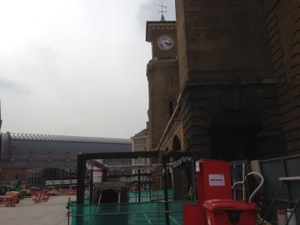 A quick sneak shot of the front of the station now the green canopy has been removed and what appears to be the framework for the rain shelter is going in. I just stuck my phone through the hoarding hence the acute angle. Look forward to seeing the whole thing soon.
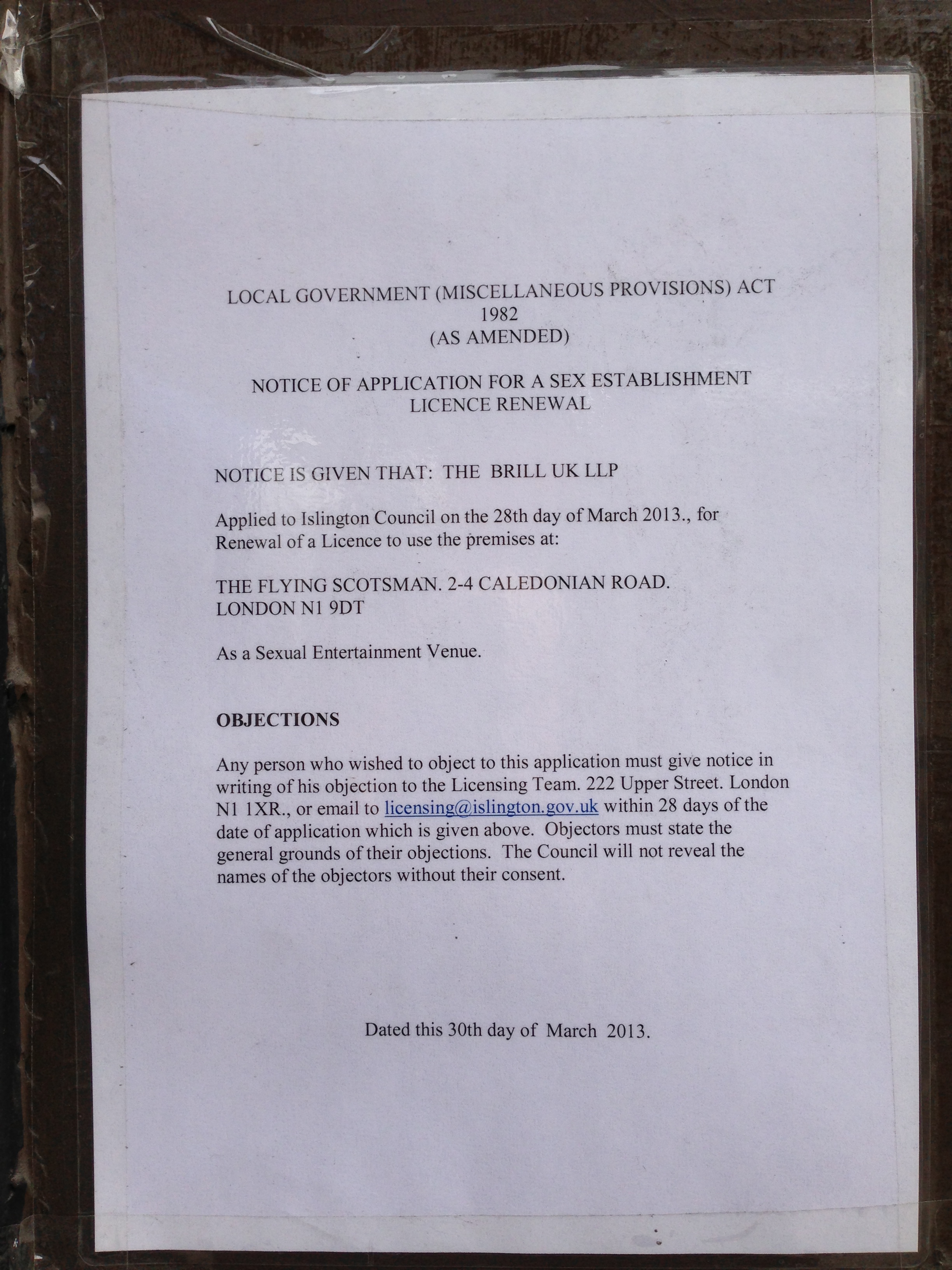
The Flying Scotsman on the Cally has offered striptease for donkey’s years. It’s a budget establishment and for many is redolent of Kings Cross’s seedy past as a red light district. We wrote this up in detail last year when the Scotsman applied for their regular licence renewal. Given the debate last time, it seems some objections from the community could lead to the licence not being renewed. If you wish to object or support write to licensing@islington.gov.uk – if you say that you wish your comment to remain anonymous, then it will. You have 28 days from 28 March which is roughly 26 April. The council is obliged to take into account ‘any reports about the licensee and management of the premises received from residents, council officers or the police and any evidence of complaints about noise or disturbance caused by premises‘.
Last year, Cllr Convery said:
‘I have met with the applicant and I am reasonably convinced they do intend to close-down this bar within 12 to 18 months and move to something like a gastro-pub. It’s a family-owned business that owns all of the terrace at 2-8 Caledonian Rd including Kesyton House and the former Brill restaurant. The business has struggled to raise the capital to redevelop the whole building to a new standard and it deserves some help with this endeavour. The license to be granted on 25th March is only for a year. I am fairly sure that if the applicant gives such an undertaking but then does not deliver on it, the committee would turn-down the next annual re-application’
Edit history -I left out a ‘not’ above about the renewal on first publishing
 Local charity King’s Cross Community Projects has been working on the green sculpture project on Wharfdale Road for a while now and is very pleased to say that this morning they set the date for installation: 8am to 4pm Saturday 13 April 2013.
The sculpture is by artist Neil Ayling and will be planted up to a design by landscape artist Marie Clarke. Both are locally based. John Ashwell has designed lighting and ‘trellis’ and future garden maintenance will be by Mike Jackson, both live on Wharfdale Road. News about the project including designs can be seen on-site at the western end of Lighterman House, Wharfdale Road and on their website.
A road closure won’t be needed despite the sculpture being a massive 10 meters high by seven meters wide, but traffic will be directed around the truck carrying the sculpture.
After the sculpture is installed on consecutive following weekends:
King’s Cross Community Projects would like to thank everyone for their patience and apologises for any inconvenience during the works. By the end of the project the group hopes to have provided a piece of public art for the whole community to enjoy which will also be an attractive vertical landscape and a wildlife oasis in a location that was unloved and a bit ugly.
Contact King’s Cross Community Projects if you have any queries about the project.
 | William Pitt-Jones on Rufford Street local hist… |
 | Shirley Nicholson on Kings Cross voices back on the… |
 | Cally Labour Council… on End of the road? |
 | Daniel Z. Zylberszta… on End of the road? |
 | Tony Rees on End of the road? |
| Daniel Z. Zylberszta… on Yes! It’s all gone 20 mi… |
 | Edward on Yes! It’s all gone 20 mi… |
| TFL Consultation… on New Consultation Launched for… |
 Pollution levels on Euston Road King’s Cross weather (BBC)
 Kings Cross Environment
