St Pancras Old Church Thomas Hardy and Quire Music event

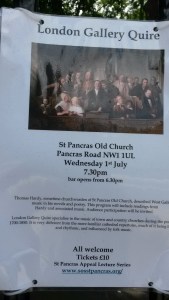
St Pancras Old ChurchThomas Hardy, sometime warden of St Pancras Old Church, described West Gallery Quire music in his novels and poetry. This programme will include readings from Hardy and associated music. Audience participation will be invited.

London Gallery Quire specialise in the music of town and country churches during the period 1700-1850. It is very different from the more familiar cathedral repertoire, being rhythmic and influenced by folk music.

Wednesday 1st July
7.30pm (bar opens from 6.30pm)
Part of the St Pancras Appeal Lecture Series
St Pancras Old Church

Pancras Road NW1 1UL
Tickets £10

Posted in Architecture, Arts and Entertainment, Community stuff | Tagged , , | 1 Comment

Support St Andrews School

2015-06-25 16.13.05Summer fete Saturday 4th July from midday at St Andrews on Matilda Street behind Barnard Park.

Posted in Arts and Entertainment, Community stuff, New, Noticeboard, Things to do, Young People | Tagged , | Leave a comment

The neighbours that desperately need our help

Islington Park Street residents

(Left to right) Siobhan McSweeney, Karen Grace, Keith Soutar. Photograph: Karen Robinson for the Observer

Just a mile away from King’s Cross is the long established community of Islington Park Street, 18 mixed-need residents, living in four victorian properties knocked into one large home, who provide mutual support in a caring communal environment. The community is about to be destroyed.

“We are a diverse group, with varied backgrounds, ethnicities, religions, political views and occupations. We always maintain an equal gender balance in the house. Our youngest resident is 19 and our eldest is 79. Some of us have significant care needs and others do not. To differing degrees, we all rely on support from the community for our physical and emotional well-being.”

The property was owned by the small housing association, Patchwork, who some readers may remember. It was set up in 1976 to provide a supportive home for life for its residents. For one resident this has been his home for 35 years having been placed here by social services aged 16.

“The intention was to create mixed-need communities, where individuals with support needs co-existed with others who were able to provide non-professional care and support. Our community has proudly continued this tradition up to the present day.”

“Living in a community helps with the inevitable loneliness of an exciting but increasingly isolating metropolis. There is always someone around to talk to in our house and evening meals gives everyone a moment to meet and talk together. Increased isolation is particularly a growing problem for the elderly in London; our older residents benefit significantly from the social interaction that this way of living allows. We think we manage to strike a balance between support and individual privacy.

“Residents’ physical health also benefits as we support each other through periods of sickness.

“We take it in turn to cook healthy meals for each other. We can afford to buy better quality food than individuals could afford if they were living alone. Those who are no longer able to cook are provided with meals by other residents.”

This is a very special community and is in imminent danger of being destroyed. This is where we come in.

Deregulation of housing associations in the 1990s brought in the new legal designation ‘registered social landlords’ (RSLs) and resulted in the small housing associations that had concentrated on particular needs within communities being bought by larger, predatory housing associations. The RSL landscape looks very different today. My own RSL, Places for People, is the result of several mergers and acquisitions eating up small targeted housing associations like so many flies. It describes itself as:

“…one of the largest property and leisure management, development and regeneration companies in the UK. We own or manage 148,000 homes and have assets in excess of £3 billion.”

In 2005 all of Patchwork Housing Association’s properties were purchased by One Housing Group for £1. One Housing Group now want to evict the residents to either sell or redevelop the property. It stands to make a great deal from this eviction.

The residents are campaigning to stop One Housing Group forcing them out in a bid to make this valuable model of best practice secure for the future. Without the constant support the vulnerable residents receive from each other their need for interventions by social services are likely to increase massively. The impact the loss of their home and their community will have on their lives does not bear thinking about.

Please help stop this horrendous injustice to our neighbours just up the road.

You can read more about their campaign on their website, in the Islington Tribune, the Guardian and the Observer. Radio Four broadcast two interviews earlier this month.

Here’s what you can do to help

Islington residents can email Cllr James Murray, Executive Member for Housing and Development, at Islington Council asking him to support the residents in their attempt to keep their home. Make sure you include your postal address to show you are an Islington resident.

Everyone can sign the petition to Islington Council.

Everyone can sign the petition to One Housing Group

Posted in Community Health and Welfare, Community stuff, New, Noticeboard | Tagged , | Leave a comment

CallySouth want Caledonian Road two way traffic system removed

Local residents group CallySouth organised a public meeting attended by 50 people at the Driver pub on Monday June 8. The meeting’s aim was to discuss ways to return traffic levels on Wharfdale Road to those that existed before the new two way traffic on Caledonian Road between Wharfdale Road and Caledonia Street was implemented in November last year.

Chaired by Daniel Mortlock, speakers were Councillor Paul Convery, Paul Taylor Islington Council’s Transport Engineering Manager and Martijn Coojimans Islington’s Senior Project Manager leading on removal of the King’s Cross gyratory system.

The two way system was brought in anticipating Transport for London’s options for removing the King’s Cross gyratory, however these have been delayed. It’s aims were to:

  1. Reduce congestion on Caledonian Road south of Wharfdale Road;
  2. Calm aggressive driving and use physical ways of slowing traffic;
  3. Make the pedestrian crossing between Wharfdale Road, Caledonian Road and Killick Street safer for pedestrians; and to
  4. Make the area covered by the new layout safer for cyclists.

Paul Convery apologised to residents for the new, possibly worse, problems the two way system has thrown up stating, ‘This is not how it was meant to be’. He explained that the new Wharfdale Road/Caledonian Road traffic lights have never worked properly – they stay red for far too long on Wharfdale Road allowing traffic to build up and remain stationary outside residents homes. One resident living next to the junction has covered their window with foam and more than one have started sleeping in alternative rooms because of the noise and fumes. He previously promised to have this fixed in March this year, the new promise is that they will be fixed by 18 June.

Residents felt that the new system was a huge mistake and unacceptable even if the traffic light phasing is corrected. The overwhelming majority present want the two way system removed and the roads returned to their pre November 2014 design. One of the two residents against reverting to the old system lives on Caledonian Road south of Wharfdale Road. He felt that prior to the new system the traffic build up on Caledonian Road had resulted in himself and his neighbours suffering worse problems than currently experienced by Wharfdale Road residents as they had three lanes of static traffic at busy times of day.

Cllr Convery promised to send residents a copy of the traffic modelling report completed prior to the new two way system, road traffic accident statistics for the area and details of what standards were used to decide that new traffic saturation levels on Wharfdale Road would be acceptable.

CallySouth campaigners have achieved a major victory in getting the council to install air quality monitoring on Wharfdale Road. The Council will have their first results shortly and these will be used to compare to 2010 levels – the last year air quality monitoring was done on Wharfdale Road. The results will be made available to residents.

A number of specific issues were raised and discussed including:

  • Requesting that Transport for London give permission for Islington Council to ban HGVs on Wharfdale Road (although enforcement of this is highly problematic due to loopholes in the law that would be used)
  • Stopping New Wharf Road and Lavina Grove being used as short cuts for A road traffic stopped at the new traffic lights
  • Keeping the no right turn at Goodsway to prevent additional traffic heading onto Wharfdale Road. This is governed by Camden Council, Islington Council will request they keep the no right turn.
  • Requesting that Transport for London review traffic light phasing and design of the Wharfdale Road/York Way junction. Ideally the constant flow of traffic from both north and south York Way needs to be interrupted. A north/south crossing at York Way removing the pedestrian sheep pen would also be desirable.
  • Getting a voluntary agreement from the Cemex cement works not to send cement trucks down Wharfdale Road. The route via Goodsway and Midland Road to Euston Road would be more acceptable as these are not residential.
  • Stopping Tesco lorries and taxis blocking Caledonia Street as this discourages its use as the alternative to Wharfdale Road for Caledonian Road northbound traffic.
  • Making the south section of Killick Street no entry onto Caledonian Road. This would allow more time to be given over for traffic to have a green light when on Wharfdale Road.

Cllr Convery made the commitment that if the problems with the two way traffic system cannot be fixed it will be returned to its previous design.

Minutes of the meeting are available at the CallySouth campaign website.

Posted in Community groups, New, Noise, Planning, Licensing and Regulation, Transport | Tagged , , , , , , , | 3 Comments

King’s Cross traffic nightmares – what the Mayoral candidates need to know

After widely publicised accidents and growing understanding about the impact of poor air quality, 2011-12 saw a flurry of activity from Transport for London in a bid to address the many and varied shortcomings of the King’s Cross traffic gyratory system. They held a public meeting and followed it up with various workshops. At these they promised to work with Camden and Islington councils to produce options for removing the gyratory and present these in Summer 2013.
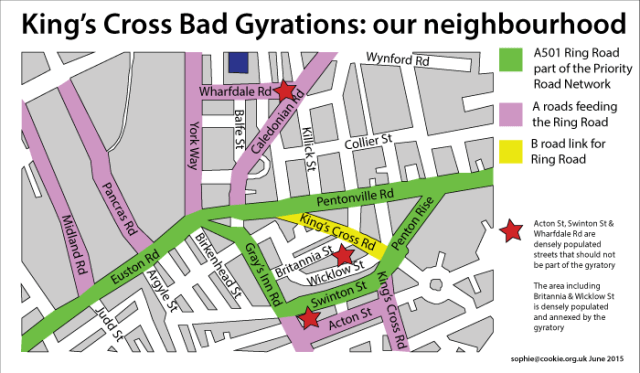
King's Cross gyratory system

Shortly after that they delayed the 2013 consultation event until summer 2015.

A few days ago they told me they were delaying the consultation until summer 2016. The same day their website was updated to say the event would now be held in winter 2016.
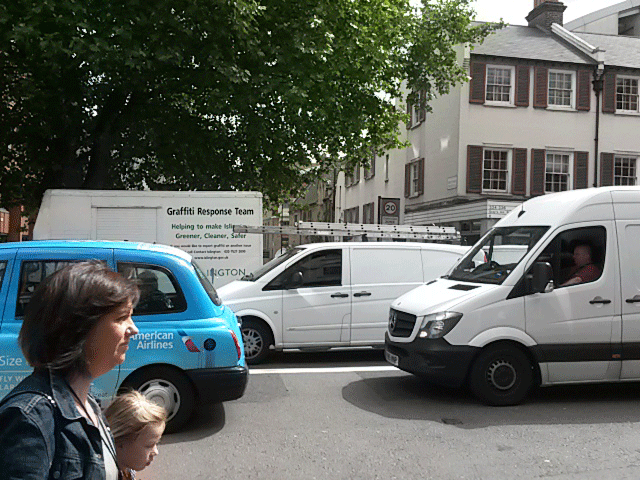
Junction at Britannia Street (BS) and Gray's Inn Road. Britannia Street is densely populated

Junction at Britannia Street  and Gray’s Inn Road. Britannia Street is densely populated. The traffic is stationary. There is no pedestrian crossing here

TfL have long been a barrier to change here, with the drive towards traffic smoothing their priority. Traffic smoothing, aka Journey Time Reliability (for motor vehicles) is a means of encouraging motor traffic to flow through the road network thereby increasing the amount of traffic. This is called ‘induced demand’. For communities in London traffic smoothing leads to bad health; inaccessible, poor quality public realm; and disjointed communities cut off from important facilities.
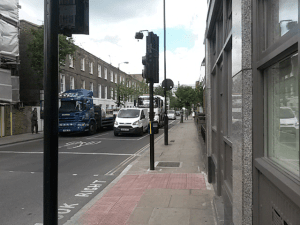
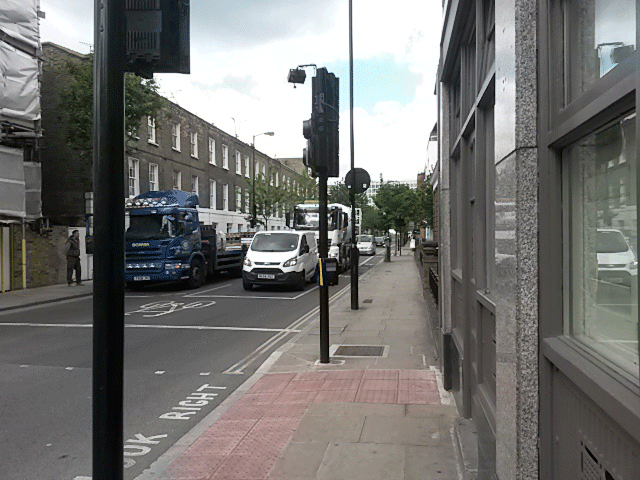
Wharfdale Road looking west. Traffic jam

Wharfdale Road looking west

Are TfL involved in a conspiracy to keep delaying the King’s Cross gyratory and public realm proposals, particularly in the run up to the Mayoral election in May 2016? Do TfL hope that a change of Mayor will at least delay it if not put a stop to it altogether? Is this a war of attrition, are TfL wearing down the local community aiming to end our demands that the gyratory be removed and replaced with a safe, healthy and liveable public realm? Is TfL pandering to the more conservative (small ‘c’) folk out there who would prefer the gyratory stays, as it’s better the devil you know, or the Cassandra like voices who insist it’s not worth fighting for because nothing good will ever come of it?
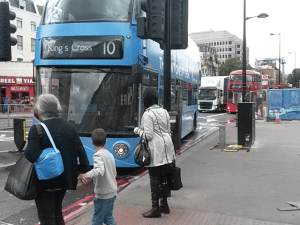
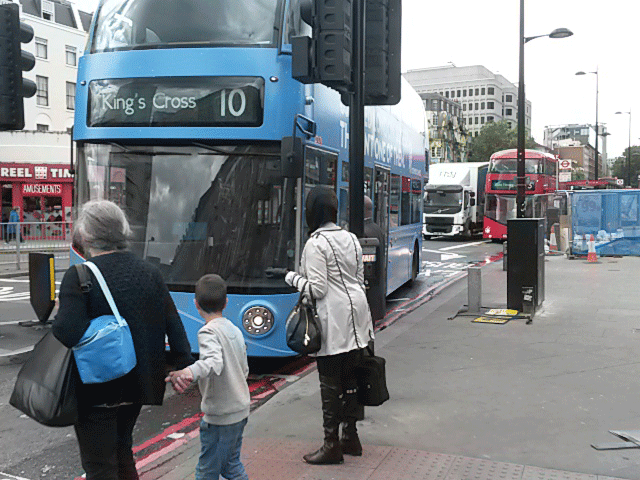
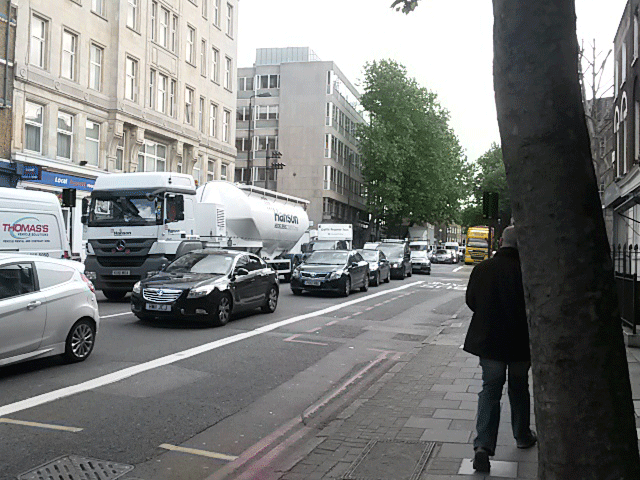
Euston Road. The area between the bus and the pavement is where cyclists are meant to go

Let’s look at what’s happening behind the scenes and see how we can keep the pressure on TfL by making this an electoral issue for all Mayoral candidates.

TfL working with the councils

It appears that TfL had not expected such commitment from Camden and Islington councils when they made their offer of working together back in 2012. Both councils have pushed TfL further than was expected resulting in delaying presenting options for gyratory removal and public realm improvements to summer 2015. This is apparently also the reason for the further delay to winter 2016, although it sits uneasily that this reason is being used for both delays. A bit of digging however reveals that TfL made big changes early this year in the way it’s approaching King’s Cross gyratory removal and public realm improvements.

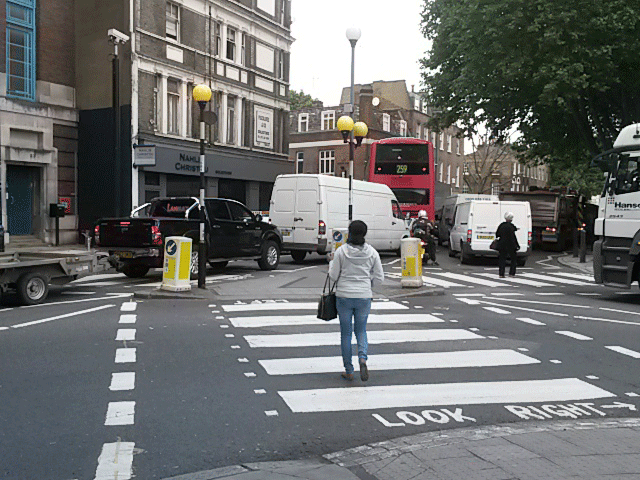
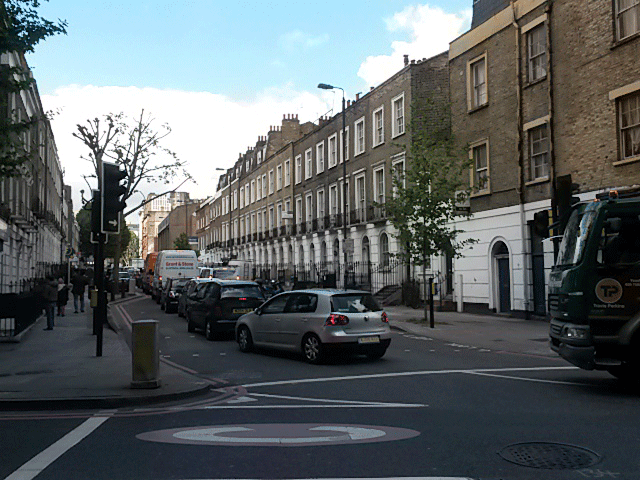
Traffic on Action Street which has zebra crossings at this junction with Gray's Inn Road and at the other end, the junction with King's Cross Road

Traffic on Acton Street which has zebra crossings at this junction with Gray’s Inn Road and at the other end, the junction with King’s Cross Road

Cllr Phil Jones, Cabinet member responsible for this at Camden said

“Camden and Islington have been working with GLA/TfL on this for a long time but we have been very frustrated by the slow progress. Our first preference is removal of the gyratory but there are lots of other related objectives, e.g. better facilities for walking and cycling and improvements to air quality. One of the big challenges is the nature of the Euston Road as part of the inner ring road and the difficulty of accommodating all the demands for road space.”
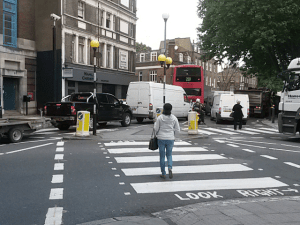
Acton Street Junction with Gray's Inn Road. Traffic is stationery (was was all the traffic in these photos). The car has a trailer and totally blocks the crossing

Acton Street Junction with Gray’s Inn Road. Traffic is stationary (was was all the traffic in these photos). The car has a trailer and totally blocks the crossing

The lead officer at Islington council explains further:

“Until the end of last calendar year, TfL was progressing the King’s Cross gyratory feasibility study [almost] internally, with occasional engagement with the boroughs.  This involvement left [both councils] with many questions about the presented design options and the methodology TfL was following. It was unclear why certain design decisions had been taken, and I did not feel confident that all possible design avenues had been fully explored. From our experience with Archway gyratory we know that only a very thorough study, exploring every possible design option, could lead to a successful outcome. Unhappy about the design approach and limited involvement of the boroughs, and unclear about the designs, I would not have been able to properly brief and advise Members and answer questions from the local community.
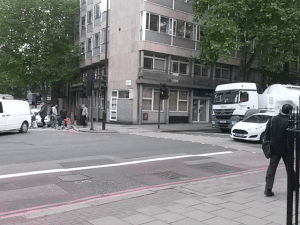
Swinton Street junction with Gray's Inn Road

Swinton Street junction with Gray’s Inn Road

“Fortunately TfL listened to our concerns and since the start of this year TfL has set up a joint project design team and working group with full officer involvement from both Camden and Islington throughout the entire design process.  Whilst this is very time consuming, it is so far proving to work really well.  I now feel confident that all possible scenarios are being properly tested, and I will be able to explain why the various options are (or are not) possible and what the trade-offs are.  To assist the boroughs in resourcing this, TfL has agreed to fund an officer post in each borough for a period, to which we are now recruiting.
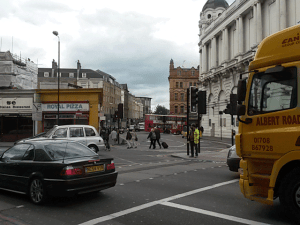
Gray's Inn Road looking across King's Cross Bridge to Caledonian Road. Ideally traffic going north would take a right turn here

Gray’s Inn Road looking across King’s Cross Bridge to Caledonian Road. Ideally traffic going north would take a right turn here

“Unfortunately this has meant that we had to take a step back so that TfL could brief us on the full design process from the start.  As a result, there is [another] delay in the programme and the consultation date has slipped.  This is disappointing and must be very frustrating for members of the local community who have been waiting to finally see some proposals for quite a few years.
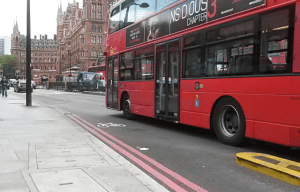
Euston Road junction with Gray's Inn Road westbound. End of cycle separation, anyone spot the problem here?

Euston Road junction with Gray’s Inn Road westbound. End of cycle separation, anyone spot the problem here?

“That said, I feel that the study is now on the right track and I am confident that the thorough approach that is being followed with involvement of the boroughs is increasing the chance of success to make worthwhile and much needed changes in the area.”

Our Greater London Assembly members (GLAMs)

Swinton Street junction with King's Cross Road. All this traffic is stationery. Swinton Street is densely populated

Swinton Street junction with King’s Cross Road. All this traffic is stationary. Swinton Street is densely populated

As with local authorities and parliamentary constituencies, King’s Cross is split into two Greater London Assembly constituencies. It would be wouldn’t it? Nothing is straightforward here. Both GLAMs are keen to know what’s going on.

Andrew Dismore (GLAM Barnet and Camden, Labour) will table a question for the Mayor this month asking for clarification about the King’s Cross gyratory proposals process and it will be very interesting to see what the quality and content of the Mayor’s reply will be.

Jennette Arnold (GLAM North East, Labour) has written to TfL also asking for clarification about King’s Cross gyratory removal and public realm improvements and is pressing them on the need to keep local people engaged and informed.

Islington’s push

Meanwhile, after a public consultation overwhelmingly in favour, Islington council implemented two way working on the south end of the Cally to Railway Street. This is a part of the gyratory the council does have sole control over. It was intended to put pressure on TfL to speed up the gyratory removal process. It comprises a redesigned junction at Wharfdale Road, Killick Street and the Cally and new two way working on the Cally from Killick Street to Caledonia Street.

At the planning stage an equality impact assessment was made which concluded that reduced crossing distances for pedestrians at the Wharfdale/Killick/Cally junction would benefit people with mobility impairments.

An environmental impact assessment was not made as the scheme would not increase the amount of traffic.

The proposed two way traffic system was modelled using industry standard software and it found, although traffic would not increase, queues of traffic would at affected junctions. The queues that would build up were expected to be ‘within capacity for the whole network’. When comparing the traffic jams at Wharfdale Road with its counterpart at Acton Street at the south end of the gyratory this is certainly the case. Jams at Acton Street are way worse than those at Wharfdale. This will be of very little comfort though, to those newly affected.

That the traffic lights at the Wharfdale/Killick/Cally junction have not been properly phased to suit the amount of traffic and type of traffic flow on Wharfdale Road has been a local disaster. When the lights at the west end of Wharfdale Road change, traffic quickly builds up into long jams at the new lights at the east end. A great deal of this traffic comprises buses, taxis and HGVs all spewing out vast amounts of particulate heavy diesel emissions. Local residents report children in particular are suffering worsened respiratory illnesses including asthma since two way working was introduced.

It is quite possible this could easily be rectified by changing the priority for the traffic lights – as simple as flicking a switch. But the council fitted an automated system enabling the traffic lights to ‘see’ where traffic is building up and change accordingly. Unfortunately this ‘SCOOT’ system hasn’t worked, the council say it is blocked by scaffolding at a building site next to the lights. Although why they can’t just manually override the system until the scaffolding comes down isn’t clear.

Residents have formed a local group, CallySouth, aiming to pressure the council to revert back to one way traffic on the south of the Cally and remove the traffic lights at Wharfdale Road. The main drive for this is to smooth the traffic flow. A public meeting to be attended by Councillor Paul Convery and council officers will take place at The Driver pub (on the first floor, no lift. Attendence limited to 60 people) at 7pm this coming Monday, all welcome but please sign up on their website so the organisers know how many people to expect.

Unfortunately, smoothing traffic flow (aka improving Journey Time Reliability) won’t improve local air quality as this worsens when traffic increases.

What the Mayoral candidates need to know

The King’s Cross gyratory controversy is not going to go away. Everyone putting their names forward to be a Mayoral candidate needs to get up to speed on what they intend to do with a planning and consultation process that has gone on for far, far too long. Do candidates intend to produce the goods here or will they get off the pot?

Gray's Inn Road looking south towards Swinton Street. Traffic is stationary

Gray’s Inn Road looking south towards Swinton Street. Traffic is stationary

TfL needs to inform and engage with the local community throughout the process. To date their ability to do this has been shambolic. How do Mayoral candidates propose to make TfL’s work actually transparent and accountable to the people they serve rather than allowing them to hide behind what has turned out to be an opaque shield of statutory ‘scrutiny’. It should not be down to volunteers on this community website to have to dig for information TfL should be feeding us and all other information outlets on a regular basis.

King’s Cross has always been a densely populated area with high concentrations of elderly and disabled people. Population here is increasing at a massive rate.

King’s Cross is more of a destination now than it has ever been and that draw will continue to increase over the next decade at least.

The local population profile is changing fast too. The Bloomsbury campus and SOAS building on Penton Rise have been joined by the University of the Arts, various new student accommodation blocks and soon the Aga Khan University will arrive here. Young people from all over the world come to study and/or live here. They tend not to drive either. They walk, they cycle and they use public transport just like the majority of existing residents and they do that on dangerous roads that have not been fit for purpose for years.

Not only is King’s Cross now known as an Arts Quarter, it has become a Knowledge Quarter too with the British Library, Guardian News Media, Google, Macmillan Publishing, the London Canal Museum, the Creative Industries Federation, The Crick Institute and the Institute of Physics among many others who have joined together to interact and share ideas in close proximity. There is nowhere else like this.

This isn’t a time for feint hearts.

Mayoral candidates listen up, here’s what you need to know:

King’s Cross is changing at blistering speed. You cannot allow this wonderful area to be completely hobbled by a killer 60s road network. You cannot allow the A501 inner ring road to funnel vast amounts of through traffic down heavily residential streets. We are living each day at risk. This is time for that vision thing.

Tell us how you are going to ensure your transport dept facilitates a 21st century design for our roads, our public realm and our communities that will be delivered without further delay.

We look forward to hearing from you…

Want to get involved with the Kings Cross Bad Gyrations campaign to get rid of the gyratory? Email us by clicking here.
Posted in Bad Gyrations KX Campaign, Local issues, New, Road Safety in Kings Cross | Tagged , , | 9 Comments

Cally south two way traffic public meeting

meeting poster

Taken from callysouth.co.uk:

In just over a week, local residents will have the opportunity to discuss the problems caused by
the implementation of the two-way system on Caledonian Rd with one of our local councillors, Paul Convery, plus two representatives from Islington Council. We hope that a solution can be found.

The meeting will take place at 7.00pm on Monday 8th June, on the first floor of The Driver, 2-4 Wharfdale Rd.

There will only be room for 60 people, so we may have to limit attendance to residents of the worst-affected area: Wharfdale Rd, Caledonian Rd (up to the canal bridge), Northdown St and Balfe St.

Please leave a comment on our website telling us whether or not you will be attending, to give us some idea of how many people we can expect.

Over the next week, we will be posting information on our site about the environmental impact of traffic on the area, along with some questions that we want the council to answer.

Our yellow posters and flyers will be appearing around the area over the next few days!

Thanks to Lynne at callysouth.co.uk for this article

Posted in Noise, Noticeboard, Road Safety in Kings Cross, Transport | 3 Comments

Where can I vote in Kings Cross?

ballotboxYour polling card should say where you can vote with a map on it.  If you can’t find your polling card then you can go to your local polling station and they can look you up on the register.  Your polling station is based upon where you live/are registered to vote and will be open from 0700 to 2200 on Thursday.  To find it if you are in Camden then enter your postcode on this website. If you are in Islington click on this map.

If you are worrying that you might not be registered then look at this useful page on the Camden website or if in Islington see this page, which isn’t quite as good.  If you can’t find any help then the best route is to go to your local polling station and ask someone at a time when it is less likely to be busy – during the working day or in the morning before work.  Evenings are very busy.

Please vote.

Posted in Democracy and Elections | Tagged , , , | 1 Comment

Air Pollution, bollocks and its mayor. A judgement to finally save us!

PM25-LONDONWhen I first discussed air pollution with my friends, amongst the parents the school my daughter was attending,  and with many others, they often looked at me, as if I was some sort of green radical. Maybe I am.  I simply looked at the evidence creeping up from time to time, though instinctively most people in Kings Cross can see the evidence against their windows in form of black dust, mainly sulphur remnants from Diesel engines. And that’s but the dust you can see, the more dangerous stuff, PM10 and PM25 small particulates, enter our lungs and bodies deeper but are invisible to the naked human eye. Still, astonishingly many people did not think I was giving them any meaningful information, when I quoted them studies that showed, that the proximity of 100 meters of a school to a road with a volume of more than 10.000 cars (Kings Cross!) showed a scientifically significant increase of Asthma incidences in children, or the many other studies on the health implications of air pollution.

I don’t blame those people for looking at me that way. The media in England, except The Guardian (see here an article from 2010), and slightly behind the BBC, was quite slow to react to all of this. Only last year during the combined Saharan and  London pollution smog was it, that I had finally a feeling, that the Evening Standard, that paper given out freely to Londoners these days, and often their only news update, was finally decisive in highlighting the problem.

In my own borough of Camden, the council was however acutely aware of the problem and run two summits on air pollution, the second one in conjunction with Islington. Whilst councillors knew about the issues and did what they could, they fought a scandalously and intentionally lame and deaf TfL, “Lord over all our roads,” and ruled over by above all one man, Boris Johnson.

Remember the days we were told the sprinkling of some substance over the tarmac of our roads was called the answer to air pollution, and that the figures everyone else produced were exaggerated? Anything but reduce traffic! Even last year Boris Johnson was still laughing at people’s concerns on air pollution by comparing London to Bejing or Mexico City. and stating people like myself are bollocks for complaining about the air.

For this was the man who in 2010 abolished half the then existing congestion zone, in a part of town where wealth means that possession of a car, if possible as large as possible – giving us the lovely idiom “Chelsea Tractors” –  and driving it, is seen by many almost as a right in itself. A salute to the Conservative Party loyal boroughs of Kensington and Westminster.

Gone was also the idea of an electric tram connecting Kings Cross with the South, which was set to be build by Ken Livingstone on some of the old tracks last used in late 1950s, when petrol driven Routmasters were cheaper to run than electric trains, and the tram was abolished largely. And the Routemaster was then precisely the strategy of the new blond London mayor, abolishing that plan as soon as he set office and advocating instead a new Routemaster, when red Ken’s red bendy bus seemed inadequate for London’s roads.

Labour and the Greens argued that it was more efficient and more ecological to spend the new Routemaster money on greening the existing fleet, fitting the highest standard exhaust emission filters and a hybrid system on them. This has now been confirmed, namely that the new Routemasters are less ecological than argued by its lobby. Also already forgotten by many, is the chapter of an attempted botched introduction of a hybrid refit technology for all London black cabs, failed back in 2008, when the procurement process of Tfl was flaunt, breaching trademark issues. But black cabs contribute, in the mayors own words, to 1/3 of the particulate matter emissions in London. On the positive side, I hear that this January an electric black cab is finally being piloted (it was first spoken about many years ago), and months after Nissan dropped its plans for a new London cab.

For decades here at Kings Cross, where I live, many including myself  have lobbied for an easing of congestion, and the road flow of the gyratory system, not just because of the air pollution the vehicles cause at the moment, but also because of the noise they create (we had to fight 13 years to win an argument with the housing association Circle 33, to fit a double window system, as the single sash windows allowed in all the noise), and because of safety concerns. When the new mayor sent a quango about two years ago to Kings Cross to conduct yet another study on the gyratory, the appointed field researcher asked us, if we accepted that the traffic needed to flow through our streets, and that this could not change. My answer was, “No, if you look at many major cities like Amsterdam, you can see how traffic even around the main stations has been transformed.” “Why not”, I asked, “in London?” The bewildered look of the researcher showed me, he was the one who failed to understand, seemingly unexposed to global alternatives, and probably hand chosen by TfL to provide solutions to the “car is king mayor.” At the last possible opportunity Johnson fiddled recently with the congestion zone, having been under immense pressure by most members of the GLA, but not before another consultation, whose results were predictable: Yes we are going to enforce a stricter ultra low emission zone, along the congestion zone perimeters – with the headlines a self-laudatio to the mayor “world’s first ultra low emission zone coming” – did we forget to shout hooray and open that champaign bottle at Kings Cross, with half of the area still outside that zone, streets like Euston Road, Swinton Street, Grays Inn Road, Kings Cross Road and Pentonville Road and Rise ?  No chance Johnson would enlarge the zone, you see.

Many, like the four London councils Hackney, Lambeth, Camden and Southwark argued that without a strategy for all of London, doing a bit in the centre has little real effect.  Having not done much of great significance for most of his tenure, Johnson can now argue he is finally green having implemented some changes in the last quarter of his many years in office. Yes he introduced the ultra low congestion zone, yes he enlarges the cycling infrastructure, but most of all, now he will have to deal with that supreme court judgement on Human Rights ground, the kind of dictum the Tories are very keen to take Britain out of, if they win the next elections.

From where I live, in the midst of Kings Cross the damage the policy of the mayor  caused for most of his tenure is clear to see. The dark dust against my window may take off a few years of the lives of all of those who live here, including myself. On many days we have to switch on an in-doors air filter (we are lucky enough to have bought one, but the carbon filter needs replacement every six months at a cost of about £100 Pounds), not the least to note that cars speed in these roads at speeds of up to 50 miles at times. Something by the way that again has finally been heard after decades, I learned there will be a trial 20 Mile zone around Kings Cross soon – hey congratulations, myself and others argued for this for more than 15 years.  The word trial here is a clear indication of how careful TfL is not to upset drivers too much (it is only a trial, we won’t inconvenience you permanently?).

That the supreme court has now argued that, since Boris Johnson came to power, he and his gang and his governmental colleagues from DEFRA, had us for an illegal unhealthy London walk on air pollution and that we, the so called and belittled urban bourgeoisie, were after all correct on air pollution and the traffic, and yes that our human rights were breached, our access and right to clean air in our own homes taken by one arrogant man, is astonishing. It is beyond me that anyone could even think of the man with his unkempt blonde hair as an adequate future prime minister, MP or mayor. He may be witty and funny at times, I am willing to concede that, but as a politician he is intentionally and cleverly obstructive, if a policy does not fit his Weltanschauung. This was for a long time to allow cars without much modification full access. It is simple to understand why. Getting tough here angers all fleet owners and cab drivers and that is bad for votes. But the twist of the story is, that the drivers of cabs and vans, who are on London’s streets day in day out, are actually those people who should be most interested in cleaner and more stringent standards, because it is them who sit right behind the exhausts of others for hours without end. And it is not as if we do not know what can make the change happen. Alternative engine technologies exist, just as there are countless examples of how urban landscapes and the minds of people can be opened and altered.

There is only one way forward, cleaning up the air in London with the latest filters and engines and road lay outs. I wonder if we will have a garden bridge first though (that other vanity project), before these changes will be introduced?

And there are, to borrow the only value in the Tory mindset, business opportunities within for all involved. New engines, trams, charging points, cycle shops, et cetera also create new jobs and create innovation that drive forward business and clean up our city’s air. And at Kings Cross, amongst the most polluted zones in London, we really need a fresh breath of air.

We will not stop to give a sample taste of our toxic fumes to any governmental office holder, who has not yet inhaled them.

To better air and health!

Posted in Bad Gyrations KX Campaign, New | Tagged , , , , , , , , , | 12 Comments