We asked for ideas, suggestions and proposals to contribute to developing the initial design being consulted on by Transport for London (TfL). Here we reproduce Tom Harrison’s proposal.
For over thirty years local residents here have campaigned for removal of the one way system – the gyratory. We were told over and over again this would never happen because York Way could not be made two way. Apparently the left turn from York Way into Pentonville Road was just too tight and the Macdonald’s building could not be removed. Well, TfL has bravely come up with their initial design to remove the gyratory without knocking down the Macdonald’s on the corner and for that they deserve praise.
Now we need to act with a real vision for the future of King’s Cross taking into account the high pollution levels we suffer, the dangers of road traffic accidents, lack of adequate walking and cycling routes, lack of quiet enjoyment of our homes and lack of decent public realm which blights our sense of being a community.
Tom Harrison has started a stunning, detailed piece of work to produce just that. As Tom says, it’s not complete – there are hurdles that would need to be overcome to stop rat running and so on. But as a starting point, this is inspiring. In addition to the article here please do look at Tom’s Google map where he goes into a great deal more technical detail (click on the elements in the side bar of the Google map to see more detail).
Tom writes:
“Making Kings Cross work for locals, pedestrians, people cycling, and public transport users. A genuine transformation is possible, and worth asking for.
- TfL’s aims in tackling Kings Cross are to be welcomed.
- Accommodate planned growth and support anticipated increase in footfall
- Improve safety for all road users, particularly pedestrians and cyclists
- Better balance the impact of traffic with the need to create an improved place to live, work and visit
- Improve cycling facilities throughout the area and support new cycle routes developed as part of the Mayor of London’s Vision for Cycling
- Make it easier for pedestrians to move through the area and access public transport
- Provide appropriate facilities for taxis, private hire vehicles, coaches and freight
- Maintain high quality bus routes in the area while balancing overall traffic demand
- Improve local air quality and street environment
It is deeply disappointing that this has slipped into thinking only about turning one way roads two way for motor traffic.
In rethinking King’s Cross’ roads, TfL must start with how to best accommodate these three groups, rather than think how they can fit around a network of two way motor traffic. And of course, we must ensure the changes put an end to the excessive ring-road traffic on the streets that really should be residential, including Wharfdale Rd, Acton St and Swinton St.
Almost 20 years ago, Transport for London’s predecessor, London Regional Transport, commissioned a study on how to improve conditions for pedestrians, cyclists, and bus users while reducing the dominance of motor traffic. The findings were conclusive and remain relevant today:
“well-designed and well-implemented schemes to reallocate roadspace away from general traffic can help to improve conditions for pedestrians, cyclists or public transport users, without significantly increasing congestion or other related problems”
TfL should follow this advice now. In what follows I will try to summarise exactly how they could do this.
Cycling
Starting with cycling routes, TfL must recognise that people will cycle along direct routes, and to and from destinations on main roads. They therefore need to make these key desire lines safe with physically protected cycle lanes. By reallocating road space, high quality lanes can be build East-West on Pentonville Road and Euston Road, and North-South on Grays Inn Road and York Way. To fit the cycle route in, you would need to find someone else for buses to park. Kings Cross Rd could be a good choice. In my view, this cycle provision is essential as without it, people’s health and safety are put at risk, either from collisions, or by being prevented from realising the health benefits of cycling.
Buses
Good bus routes are also vital for such an important international train station. These could be prioritised more by making certain roads, bus only, including the northern end of Grays Inn Road, and the southern end of York Way. Euston Road could also be significantly improved with wide crossings to enable easier interchange between buses on either side of the road.

Pedestrians
For pedestrians, Grays Inn Road and York Way would be significantly improved with reduced noise and air pollution from no through motor traffic. And the same can be achieved for Wharfedale Road, Swinton St, and Acton St. Pavements could also be widened on Cally Rd.
Through motor traffic
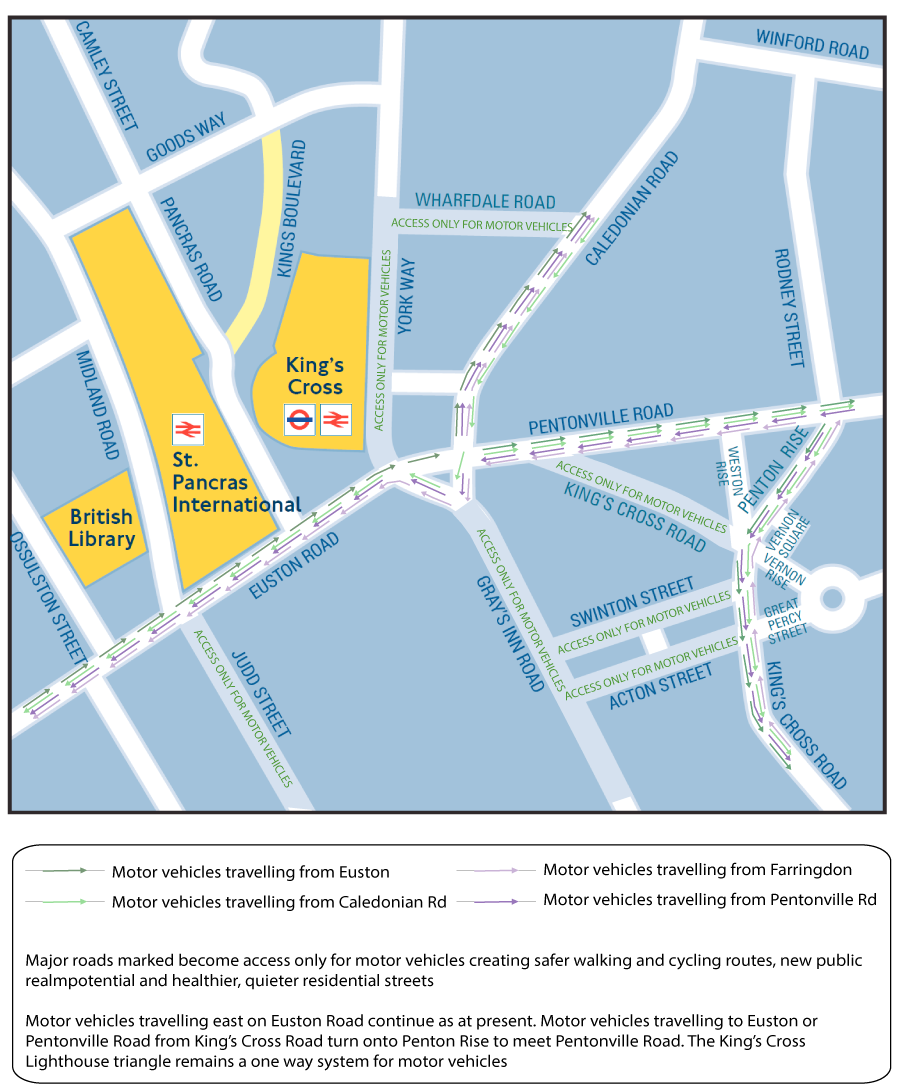
That leaves through motor traffic going along Pentonville – Euston Rd and Cally Rd – Kings Cross Rd or Penton Rise. There would need to be a set of well placed banned turns or “modal filters” (sometime called road closures) to make sure through traffic stuck to these routes and prevent further rat running on Britannia St, Rodney St and elsewhere.
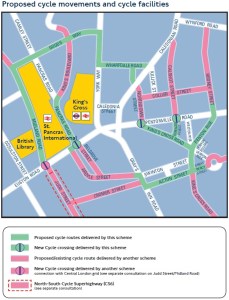
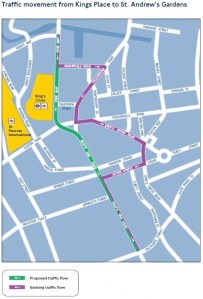
To explain it visually, take a look at the three maps of the proposals. The first depicting bus movements, and the second, that of through motor traffic. I’ve also made a third, interactive map which you can click through to see road widths, how I suggest space should be allocated, and where traffic restrictions are likely to be needed.”
King’s Cross Development Forum is hosting a meeting at Camden Town Hall on Wednesday 16 March at 6.30pm about TfL’s proposals, all are welcome.
 The first contribution comes from Leah who lives with her daughter in the Britannia and Wicklow Street triangle, currently a glorified roundabout that is generally a forgotten but densely populated area of King’s Cross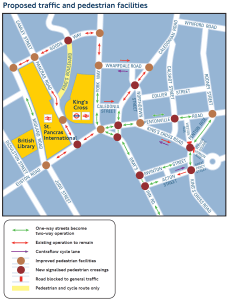





 Kings Cross Environment
“It doesn’t look like the situation will improve much for Acton Street with these proposals – and things may even get worse.
“The biggest impact is from traffic turning left into Acton Street from King’s Cross Road (going to Gray’s Inn Road and onwards to Euston Road, York Way and Caledonian Road) and it seems like this isn’t going to change. Also, depending on other turnings elsewhere, much of southbound traffic could still be using the street.
“The two-way layout at the west end of Acton Street would put all this traffic into one lane, and together with a controlled crossing at the junction of Gray’s Inn Road, this would mean more tailbacks, with buses, lorries and taxis idling and moving off again very close to homes on the south side of the street.
“Acton Street has more housing than Swinton Street, and many residents are likely to end up living in a more unpleasant environment if these proposals go ahead.”
Click to see the full TfL initial plan
Twitter user Kier:
“As a cabbie I’m normally sceptical of most of these plans but I think this can work.”
Twitter user Tom Harrison:
“Vital we avoid seeing the aim of this as simply gyratory removal. Question is how to improve Kings Cross for all users.”
Resident Daniel:
“Those of us who live alongside two or three lane long streets, are quite happy to see the end of racing, and it will be good to see cars taking more direct routes and cyclists able to go both ways. These are some improvements. Some argue, and I do not deny their point, that two-directional streets are harder to negotiate for pedestrians when crossing. In my submission to the consultation I said that on the longer roads there should more crossings (zebra or otherwise) installed to make up for that. A real change are the extra cycle lanes though.”